
Dreaming of your own watch brand but scared by the potential cost? It's a common fear. But launching your brand is more affordable than you might think.
You can start a watch brand for as little as $3,000 naar $9,0001. This budget covers your first small batch of watches (100-300 stukken2) with your logo, plus basic packaging. This makes it possible for new entrepreneurs to enter the market without a huge investment.
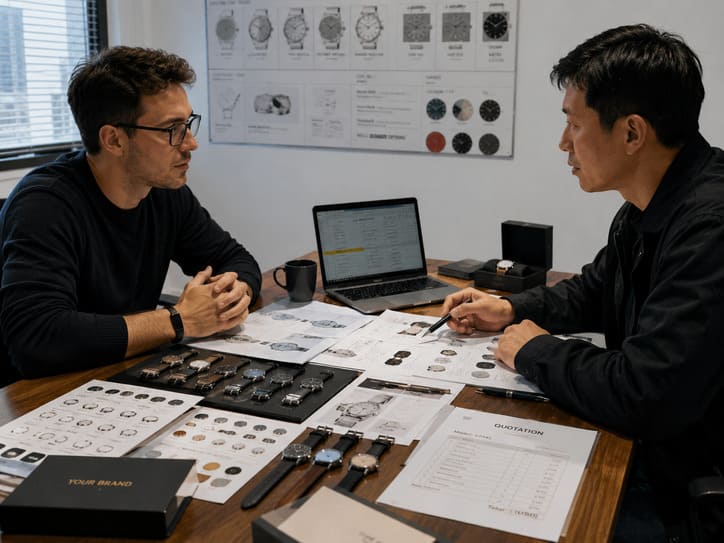
Starting a brand feels like a huge mountain to climb, especially when you think about money. I talk to new brand owners every day, and the first question is always about cost. Many believe they need tens of thousands of dollars just to get started. The good news is that's not true. You have options, and understanding them is the first step. Let's break down the real numbers so you can see how to turn your idea into a real product you can sell.
What's the minimum budget to launch a watch brand?
Feeling stuck because you think you need $50,000 to start? It's a common myth that holds people back. The reality is much more accessible.
You can start a watch brand for as little as $3,000 for a micro-batch or around $9,000 for a more customized first run. The lower-cost option uses existing designs, while the higher budget allows for more unique customization on a larger order.
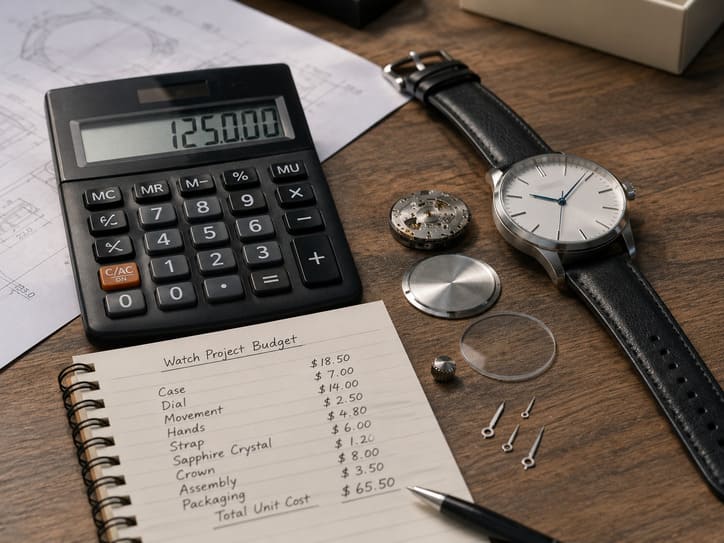
The budget really depends on your first goal. Do you want to test the market quickly, or launch with a more unique design? Both are great strategies, but they come with different price tags. I've worked with founders who started with both approaches. The key is to match your budget to your business plan. Let's look at the two main paths you can take for your first production run.
The Micro-Launch vs. The Custom Launch
Your starting investment is tied directly to your Minimale bestelhoeveelheid (MOQ)3 En level of customization4.
- The Micro-Launch (around $3,000): This is the perfect entry point. You choose from one of our existing, production-ready case designs and we add your custom logo and dial. Because the tooling is already made, we can offer a lower MOQ, often around 100 stukken. It's low-risk and the fastest way to get your product to market.
- The Custom Launch (around $9,000): If you have a more specific design in mind, this is your path. This budget typically covers an MOQ of 300 stukken. It gives you more freedom to customize the dial, handen, achterkant van de behuizing, and other details to create a watch that is truly yours.
Here is a simple table to compare the two options:
| Functie | Micro-Launch (100 stuks) | Custom Launch (300 stuks) |
|---|---|---|
| Estimated Cost | ~$3,000 | ~$9,000 |
| Design Uniqueness | Medium (Aangepaste wijzerplaat) | Hoog (More Custom Parts) |
| Risk Level | Laag | Gematigd |
| Tijd voor de markt | Faster | Longer |
How do watch unit costs break down?
Confused about what you're actually paying for in a single watch? It's easy to get lost in quotes. Let's make it simple and clear.
A typical entry-level custom watch costs around $20-$25 per unit from the factory5. This price includes the watch head (geval, beweging, wijzerplaat, handen) and a standard strap. Premium materials, like a Swiss movement or sapphire crystal, will increase this base cost6.
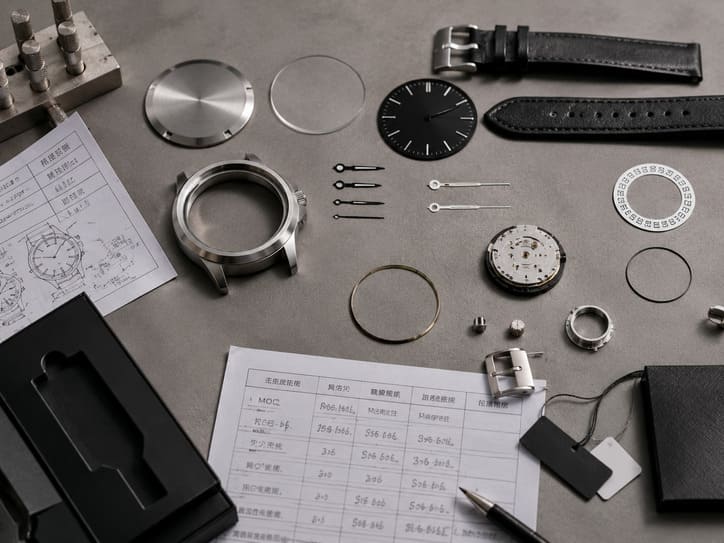
When you get a quote from a manufacturer, you're looking at the "ex-factory7" price. This is the cost to make one complete watch. But what makes up that price? It's not just one thing; it's a sum of all the small parts and the labor to put them together. Understanding these components helps you make smart design choices that fit your budget. Bijvoorbeeld, changing the movement is one of the biggest factors that can affect the price. Let's dive into a typical example.
Anatomy of a $22 Horloge
Let's imagine you want to create a classic quartz watch. The unit cost might be around $22. Where does that money go? The cost is a combination of materials and assembly. Better materials cost more, but they also create a better product for your customers.
Here’s a sample breakdown of how that $22 might be distributed:
| Onderdeel | Example Material/Type | Estimated Cost |
|---|---|---|
| Beweging | Japanese Miyota Quartz8 | $5.00 |
| Geval | 316L Roestvrij staal9 | $8.00 |
| Wijzerplaat & Handen | Custom Design, Messing | $3.00 |
| Riem | Echt leer | $4.00 |
| Montage & QC | Labor and Testing | $2.00 |
| Total Unit Cost | $22.00 |
On top of this, you have packaging. A simple, branded box might add another $2.00 per unit. Dus, your total product cost before shipping and taxes is $24.00. If you want to upgrade, you could switch to a Swiss Ronda movement or add a sapphire crystal, but each upgrade will add a few dollars to the unit cost.
Your factory quote looks great, but is that the final price? Unexpected fees can ruin your budget. Let's uncover the costs you might have missed.
Ja, there are costs beyond manufacturing. You must budget for shipping, import duties, and taxes. Shipping can add $2-$4 per watch, En taxes can be 20-25% or more of your total order value10, depending on your country's rules.
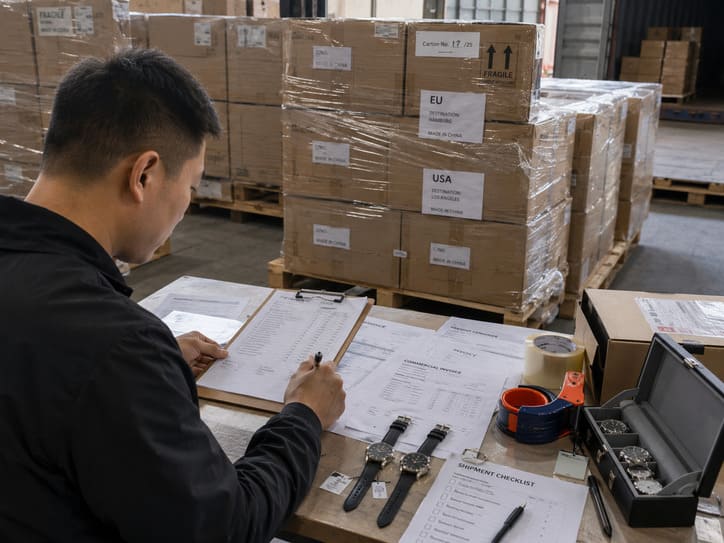
I always tell my clients to think about the "landed cost11," not just the factory price. The landed cost is the final price you pay to get the product into your hands, ready to sell. Forgetting about this is a common mistake for first-time brand owners. It can turn a profitable plan into a loss. These costs are not from the manufacturer; they are part of international trade. Let's go over the main ones so you can prepare a realistic budget and avoid any bad surprises.
Budgeting for the Landed Cost
Your true cost per watch includes three key things beyond the factory price.
-
Shipping: For small batches of 300-500 horloges, air freight is the most common method. It's faster and more secure than sea shipping. As a general rule, you can estimate shipping costs to be between $2 naar $4 per watch when shipping from China to Europe or the US. So for a 300-piece order, that's an extra $600 naar $1,200.
-
Import Duties & Taxes: This is the biggest variable and depends entirely on your country. When you import goods, your government will charge you duties and taxes (like VAT or GST). I often advise clients to budget around 25% of the total commercial invoice value (product cost + shipping) for this. For a $7,200 volgorde ($24/unit x 300), that could be an additional $1,800. Always check your local government's import regulations for exact rates.
-
Samples: Before you place a bulk order, you need samples. Sample costs are separate and can range from $100 naar $800 on existing mold, ranges from $500-$3000 depending on the complexity. This is a necessary investment to ensure the quality and design are exactly what you want.
How can I lower my startup costs?
Is the $9,000 price tag still a bit high? Don't give up on your brand yet. There are smart ways to start smaller and grow.
The easiest way to lower startup costs is to reduce your Minimum Order Quantity (MOQ). By choosing a manufacturer's existing case design and simply adding your logo and custom dial, you can often lower the MOQ from 300 to just 100 stukken.
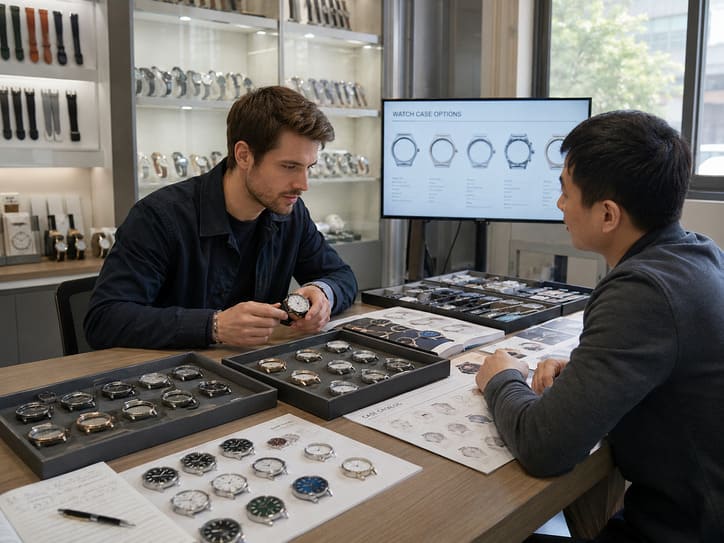
The desire to create something 100% unique from day one is strong. I see it in almost every passionate founder I meet. But a fully custom design requires new molds and tooling12, which is why manufacturers need a higher MOQ to cover those costs. Echter, a smarter way to start is by using what we call "open mold" or "factory stock" gevallen. These are high-quality, proven designs that we already have the tools for. This allows us to produce a much smaller batch for you, which is perfect for testing your brand.
The Power of Starting with an Existing Design
Choosing an existing case design is the most effective strategy for launching on a tight budget. It doesn't mean your watch will look generic. You still have full control over the most important visual elements that define your brand.
Here's how this approach saves you money and time:
- Lower MOQ (100 stukken): This is the biggest advantage. An order of 100 units instead of 300 can bring your initial investment down to that $3,000 range.
- No Tooling Fees: Creating new molds for a custom case can cost thousands of dollars. Using an existing design completely eliminates this expense.
- Faster Production: Since the technical drawings and tools are ready, we can move to sampling and production much faster. You can have your watches in hand weeks earlier than with a fully custom project.
- Full Dial Customization: The dial is the face of your watch. You still get to design it from scratch—the color, the markers, the hands, and your logo. This is where your brand's identity truly shines.
I've seen many successful brands start this way. They launch with a 100-piece collection, prove their concept, and reinvest their profits into a fully custom design for their second collection.
Conclusie
Starting a watch brand is within reach, with a realistic budget of $3,000 naar $9,000 for your first inventory. The key is to start smart by choosing the right manufacturing strategy.
"Small Batch Manufacturing Startup Costs: $465K CAPEX", https://financialmodelslab.com/blogs/startup-costs/small-batch-production?srsltid=AfmBOooyxTPLdHqkol12MxxaIj53rx4bSfUWICCYhxUPNWCbe4WDIXKA. A neutral small-business or manufacturing-cost source should support that private-label consumer products can be launched with relatively small initial inventory budgets when using existing designs and limited customization; this would contextualize, but not independently verify, the article’s specific $3,000–$9,000 estimate. Bewijs rol: algemene_ondersteuning; brontype: instelling. Ondersteunt: A watch brand can be launched with an initial budget of about $3,000 naar $9,000.. Reikwijdte opmerking: The cited source may support the low-budget private-label model generally rather than the exact watch-brand price range. ↩
"A 2026 Guide to Minimum Order Quantity (MOQ) - Impact Analytics", https://www.impactanalytics.ai/blog/moq. A manufacturing or supply-chain source should document that minimum order quantities are commonly used in contract manufacturing and that small-batch production can involve orders in the low hundreds; this supports the plausibility of the stated batch size but may not establish watch-specific norms. Bewijs rol: algemene_ondersteuning; brontype: onderwijs. Ondersteunt: A first small batch for a new watch brand can plausibly be 100–300 pieces.. Reikwijdte opmerking: Support may be for contract manufacturing MOQs generally, not specifically for watches. ↩
"[Pdf] Raw Material Minimum Order Quantity Optimization - DSpace@MIT", https://dspace.mit.edu/bitstream/handle/1721.1/121302/1240293813-MIT.pdf?sequence=1. A supply-chain or manufacturing reference should define minimum order quantity as the smallest quantity a supplier is willing to produce or sell in one order, supporting the article’s use of MOQ as a key production-cost constraint. Bewijs rol: definitie; brontype: onderwijs. Ondersteunt: Minimum Order Quantity is the minimum production or purchase volume required by a supplier.. ↩
"[Pdf] Analyzing Product Lifecycle Costs for a Better Understanding of Cost ...", http://utw10945.utweb.utexas.edu/Manuscripts/2012/2012-12-Lindemann.pdf. A manufacturing-economics source should explain that customization increases fixed setup, engineering, gereedschap, or changeover costs, which are spread across the order quantity; this supports the mechanism linking customization to higher required investment. Bewijs rol: mechanisme; brontype: onderwijs. Ondersteunt: Greater customization can increase manufacturing setup or tooling costs and therefore raise the starting investment.. Reikwijdte opmerking: The principle is general to manufacturing and may not quantify costs for watch production specifically. ↩
"[Pdf] HTS CHAPTER 91 CLOCKS AND WATCHES AND PARTS THEREOF", https://www.usitc.gov/publications/docs/tata/hts/bychapter/1000c91.pdf. An industry-cost, import-data, or manufacturing benchmark source should substantiate that low-cost quartz watches can have factory or customs-declared unit values in the tens of dollars; this would support the plausibility of the $20–$25 estimate but may not prove the exact supplier quote. Bewijs rol: statistiek; brontype: instelling. Ondersteunt: An entry-level custom watch can cost roughly $20–$25 per unit at the factory level.. Reikwijdte opmerking: Factory prices vary substantially by supplier, materialen, order size, and country of manufacture. ↩
"Sapphire crystal [Watch Wiki]", https://www.watch-wiki.net/doku.php?id=sapphire_crystal. A horology or materials reference should support that sapphire crystal and higher-grade watch movements are premium components relative to mineral glass and basic quartz movements; this supports the direction of the cost increase without quantifying the added amount. Bewijs rol: algemene_ondersteuning; brontype: encyclopedie. Ondersteunt: Using premium components such as sapphire crystal or Swiss movements increases the base cost of a watch.. Reikwijdte opmerking: The source may establish component quality differences rather than provide exact price premiums. ↩
"Export Import | What is Ex-Factory? - Digital Exim", https://digitalexim.com/export-import-what-is-ex-factory/. An international trade reference should define ex-factory or ex works pricing as the price of goods at the seller’s premises before transport, insurance, duties, and other downstream costs; this supports the distinction between factory price and landed cost. Bewijs rol: definitie; brontype: instelling. Ondersteunt: An ex-factory price excludes later shipping, import, tax, and related costs.. ↩
"Miyota (watch movement manufacturer) - Wikipedia", https://en.wikipedia.org/wiki/Miyota_(watch_movement_manufacturer). A horology reference or manufacturer specification should identify Miyota as a Japanese watch-movement maker and document that quartz movements are widely used in battery-powered watches; this supports the component example rather than the article’s exact cost allocation. Bewijs rol: case_referentie; brontype: ander. Ondersteunt: Japanese Miyota quartz movements are a plausible component choice for an entry-level quartz watch.. Reikwijdte opmerking: The source would verify the component type and origin, not the stated $5.00 kosten. ↩
"Improving Corrosion and Wear Resistance of 316L Stainless Steel ...", https://pmc.ncbi.nlm.nih.gov/articles/PMC11818221/. A materials or engineering source should describe 316L stainless steel as an austenitic stainless steel with corrosion resistance and common use in consumer or medical applications; this supports why it is a plausible watch-case material, without validating the stated price. Bewijs rol: definitie; brontype: onderwijs. Ondersteunt: 316L stainless steel is a recognized corrosion-resistant material suitable for watch cases.. Reikwijdte opmerking: The source supports material properties and use context, not the article’s estimated $8.00 case cost. ↩
"Customs Duty Information - U.S. Customs and Border Protection", https://www.cbp.gov/travel/international-visitors/know-before-you-visit/customs-duty-information. Government customs and tax sources should show that import VAT or GST rates in many jurisdictions are around 20% or higher and may be applied to the customs value plus shipping and duty; this supports the plausibility of the budgeting range, though actual rates depend on country and product classification. Bewijs rol: statistiek; brontype: regering. Ondersteunt: Import taxes can reach about 20–25% or more of an order’s value depending on the destination country.. Reikwijdte opmerking: Rates vary by jurisdiction, HS code, valuation method, exemptions, and trade agreements. ↩
"Duty - Cost Insurance and Freight (CIF) - help.CBP.gov", https://www.help.cbp.gov/s/article/Article1126. A trade or customs source should define landed cost as the total cost of imported goods after adding freight, insurance, duties, taxes, and related charges; this supports the article’s warning that factory price is not the final cost. Bewijs rol: definitie; brontype: regering. Ondersteunt: Landed cost includes the factory price plus shipping, duties, taxes, and other import-related expenses.. ↩
"How to Estimate Injection Molding Cost?", https://formlabs.com/blog/injection-molding-cost/. A manufacturing-process source should explain that custom-designed parts often require tooling, mallen, dies, of armaturen vóór productie, supporting the article’s claim that fully custom watch designs create additional upfront costs. Bewijs rol: mechanisme; brontype: onderwijs. Ondersteunt: Fully custom product designs commonly require new molds or tooling, adding upfront manufacturing costs.. Reikwijdte opmerking: The source may describe tooling in manufacturing generally rather than watch cases specifically. ↩