
Uuden tuotelinjan kehittäminen voi tuntua kuin navigoisit äärettömien valintojen sokkelossa. When you decide to choose a men's watch to develop, that feeling is amplified by countless combinations of movements, materiaaleja, and styles. Making a misstep can mean creating a watch that doesn't connect with your target audience, leading to slow sales and excess inventory. The solution is to build a watch with intention, aligning every component with a clear purpose and customer profile.
To choose a men's watch for your collection, first define its core purpose: is it a fashion accessory or a functional tool? Then, select a movement (quartz for affordability, mechanical for prestige), case materials (like 316L steel), and a strap (nahka, steel, silicone) that align with that purpose and your target market's lifestyle. This strategic alignment ensures the final product is cohesive, marketable, and appealing to your ideal customer.
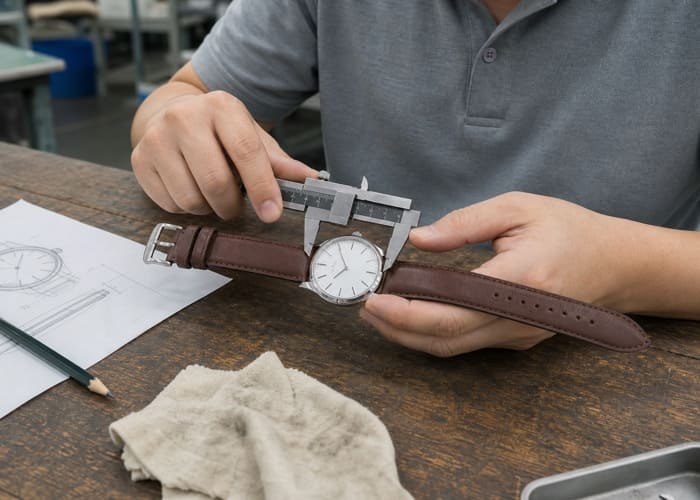
With this foundational framework in mind, we can break down the decision-making process into manageable steps. Let's explore the critical choices you'll face, from defining the watch's primary role to selecting the specific components that will bring your vision to life for your customers.
Function or Fashion: What's the Core Purpose of Your Watch?
Does your target customer need a tool for a specific task, or an accessory to complete their look? Answering this question is the single most important step in your design process. A watch designed for a deep-sea diver has vastly different requirements than one designed for a boardroom meeting, and trying to be everything to everyone often results in a product that excels at nothing.
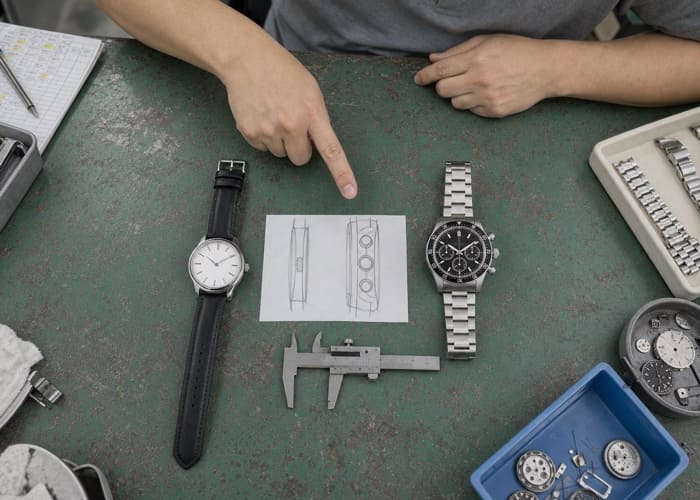
The core purpose dictates everything that follows. A fashion-focused watch prioritizes aesthetics, case thickness, and material finish. A function-focused watch, like a chronograph or diver, prioritizes durability, legibility, and specific technical capabilities. Defining this early prevents costly redesigns and ensures a focused product.
Sukella syvemmälle: Defining Your Market Niche
The decision between function and fashion is really a decision about your target market. As an OEM partner for numerous brands, I've seen firsthand that the most successful collections have a crystal-clear customer in mind.
For the Fashion-Forward Customer:
If the watch is primarily a decorative accessory, your focus should be on visual trends and timeless style.
- Minimalism: This enduring trend favors clean dials, no numerals, and slim profiles. These watches are versatile and appeal to a broad audience seeking understated elegance. From my experience, a thin case—often under 8mm—is a key selling point for business and formal wear.
- Case Color & Valmis: The classic choice is polished or brushed stainless steel. It’s timeless and durable. Kuitenkin, PVD coatings in gold, ruusukulta, or black can target different style preferences. A word of caution: gold and black can be very bold and may appeal to a more narrow, fashion-forward niche. Steel is always the safest and most classic bet.
- The "Look": For many customers in this segment, the appearance of a mechanical watch is desirable, even if a quartz movement powers it. An open-heart dial or an exhibition caseback (even with a decorated quartz movement) can provide a premium feel without the cost and complexity of a true mechanical build.
For the Function-Oriented Customer:
If your watch serves a specific purpose, the design must support that function without compromise. This is where you can build a loyal following among enthusiasts.
- Dive Watches: These are defined by their water resistance, typically rated in atmospheres (Pankkiautomaatti). A true dive watch should have at least 20 Pankkiautomaatti (200 meters) of water resistance, a screw-down crown, and a unidirectional rotating bezel to track elapsed time underwater.1 Legibility is paramount, so large, luminous hands and markers are standard.
- Chronograph kellot: These are essentially stopwatches on the wrist, featuring subdials to track seconds, minutes, and hours. They appeal to those interested in motorsports, aviation, or anyone who appreciates technical complexity. The design must ensure the main time is readable at a glance, despite the busy dial.
- Field or Pilot Watches: These prioritize ruggedness and legibility above all else. They often feature high-contrast dials (black with white numerals), durable cases, and comfortable, hard-wearing straps like canvas or nylon.
By defining whether you're building a tool or a jewel, you create a clear path for every subsequent decision in the manufacturing process.
Quartz or Mechanical: Which Movement Drives Your Brand?
The movement—or "engine"—of the watch is a critical choice that impacts price, suorituskykyä, ja tuotemerkin käsitys. Are you building an accessible, reliable timepiece or a prestigious piece of mechanical art? This decision sends a strong signal to your customers about what your brand values.
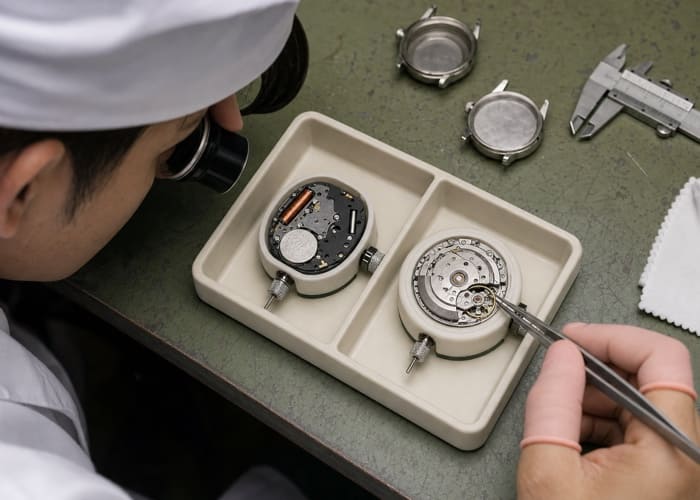
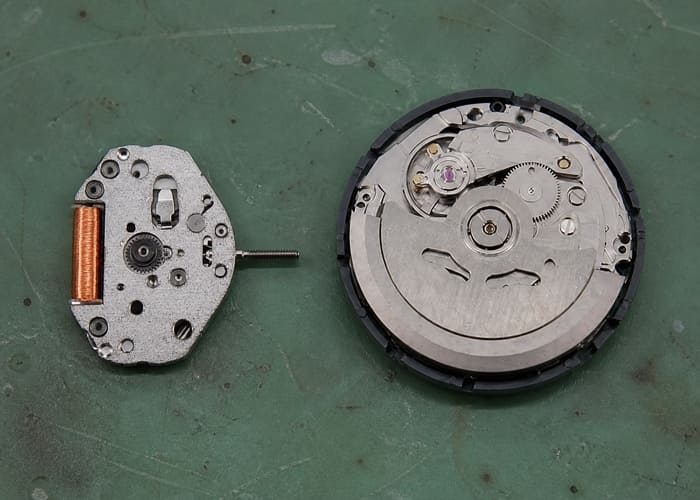
A quartz movement is powered by a battery and offers exceptional accuracy and affordability. A mechanical movement is powered by a wound spring and represents traditional craftsmanship, appealing to watch enthusiasts who value the intricate engineering. There is no right or wrong answer, only what is right for your brand.
Sukella syvemmälle: Sourcing and Strategic Implications
When we help brands choose a men's watch movement, the discussion goes far beyond simple accuracy. It’s about cost, supply chain, marketing story, and long-term value.
The Case for Quartz:
For most new and fashion-oriented brands, quartz is the logical starting point.
- Cost-Effectiveness: Japanilaiset liikkeet valmistajilta, kuten Miyota (Kansalainen) ja Seiko are the industry standard. They are incredibly reliable and affordable, allowing you to invest more in the case, soittaa, and strap quality while keeping the final product accessible. Swiss quartz movements from Ronda offer a step up in prestige and are often used to add a "Swiss Made" or "Swiss Movement" claim to your marketing.
- Luotettavuus & Low Maintenance: Quartz watches require little to no maintenance beyond a battery change every few years. This is a huge advantage for the average consumer who wants a "set it and forget it" experience.
- Design Freedom: Because quartz movements are typically slimmer and smaller than their mechanical counterparts, they allow for thinner, more elegant case designs—perfect for the minimalist and business styles we discussed.
The Case for Mechanical:
Opting for a mechanical movement positions your brand in a more premium, enthusiast-focused category.
- Perceived Value & Craftsmanship: A smooth, sweeping second hand is the tell-tale sign of a mechanical watch.2 This feature, along with the "no battery needed" aspect, creates a powerful marketing story rooted in tradition and engineering.
- Movement Sourcing:
- Japanese Automatic: Movements like the Seiko NH35 tai Miyota 9000 series are the workhorses of the microbrand world. They offer excellent reliability and performance at a fraction of the cost of Swiss alternatives. They are the perfect entry point into the world of automatic watches.
- Swiss Automatic: Sourcing movements from Sellita tai ETA instantly elevates your brand. These are used by major luxury watchmakers and signal a serious commitment to quality. Kuitenkin, they come with significantly higher costs and sometimes stricter supply controls.
- Target Audience: The customer for a mechanical watch is often more educated about horology. They appreciate details like an exhibition caseback to view the decorated rotor and moving parts. This is not just a time-telling device; it's a hobby and a passion.
As an OEM manufacturer, we guide clients through this choice by balancing their budget, brand vision, and production volume. For a first collection, a high-quality Japanese quartz or automatic movement often provides the best balance of quality, maksaa, and market appeal.3
Steel, Leather, or Silicone: How Should the Watch Feel on the Wrist?
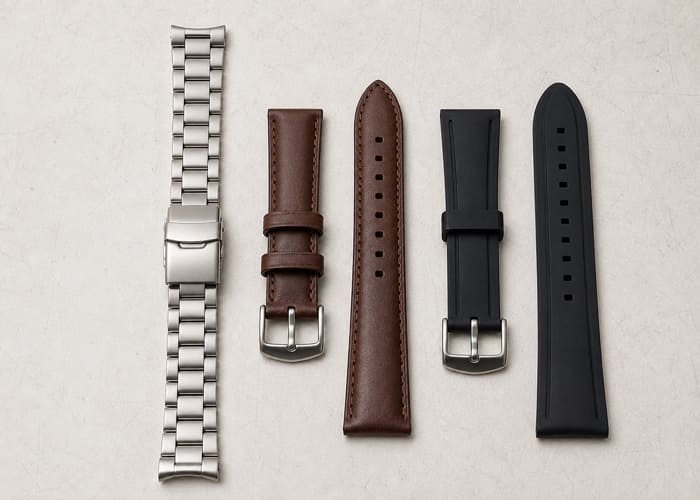
A watch is a tactile object, and the choice of strap is just as important as the watch head itself. The wrong strap can undermine a great design, feel uncomfortable, or fail prematurely. You need to consider how the strap material complements the watch's style, toiminto, and even the season it's most likely to be worn in.
Esimerkiksi, a luxurious dress watch on a silicone strap feels mismatched, just as a rugged dive watch on a delicate leather band feels impractical. The strap choice should feel like a natural extension of the watch's core purpose, enhancing both its look and its wearability.
Sukella syvemmälle: Matching Strap Materials to Use Case
When we develop a watch collection, we treat the strap as a key component, not an afterthought. Here’s a breakdown of the most common options and their strategic uses:
| Strap Material | Best For Watch Type | Plussat | Miinukset | My Advice for Brands |
|---|---|---|---|---|
| Leather | Dress, Business, Klassinen | Tyylikäs, comfortable, classic look | Wears out, not water-friendly, can be warm | Offer as the primary option for dress/business watches. I've noticed it's best for winter collections, as summer sweat can degrade it quickly. Consider offering quick-release spring bars so customers can swap straps easily. |
| Ruostumaton teräs | Dive, Urheilu, Business, Versatile | Durable, water-resistant, professional look | Can be heavy, may pull hair, requires sizing | A 316L stainless steel bracelet is a fantastic all-rounder.4 It gives a watch a substantial, premium feel. It’s perfect for summer as it doesn't absorb sweat. Offer both brushed and polished finishes to match the case. |
| Silicone/Rubber | Dive, Urheilu, Active | Waterproof, durable, flexible, comfortable | Can attract dust/lint, less formal look | The default choice for any true dive or sports watch. We often source high-grade silicone for its softness and durability. It’s ideal for watches with 10 ATM water resistance or more. Great for customers with an active lifestyle. |
| Nylon (NATO/Zulu) | Field, Urheilu, Kronografi | Lightweight, breathable, secure, inexpensive | Casual appearance, can fray over time | Nylon straps, particularly NATO style, are extremely popular in the microbrand world.5 They are associated with military and sport history. They’re a great way to add a pop of color and a rugged, practical vibe, especially for chronographs and field watches. |
 In our OEM process, we encourage clients to think about straps as part of a system. Esimerkiksi, a single watch model could be offered in several variations:
- A "dress" version with a leather strap.
- A "sport" version with a steel bracelet.
- A "weekend" version with a nylon NATO strap.
This strategy broadens the appeal of a single watch design, allowing you to reach multiple customer segments with minimal changes to the core product. It also opens up the possibility of selling straps as a profitable aftermarket accessory.
Usein kysytyt kysymykset
What is the typical MOQ for custom men's watches?
For custom OEM watch manufacturing, the Minimum Order Quantity (MOQ) is typically between 300 ja 500 kappaletta per malli. This quantity allows for efficient sourcing of custom components like dials, tapauksia, ja kädet, and it strikes a balance that is accessible for small to medium-sized brands launching a new collection.
How does water resistance (Pankkiautomaatti) affect a men's watch design?
Water resistance significantly impacts a watch's design and cost. A 3-5 ATM rating is fine for everyday splashes but requires a standard case. A 10-30 Pankkiautomaatin luokitus, suitable for swimming or diving, requires a more robust construction, including a screw-down crown and thicker caseback, which influences the watch's overall size and aesthetic.
What's the difference between OEM and ODM watch manufacturing?
OEM (Alkuperäinen laitevalmistaja) is when we build a watch based on your unique design and specifications. ODM (Alkuperäinen suunnitteluvalmistaja) is when you select one of our existing watch designs and customize it with your brand's logo, värit, ja materiaaleja. ODM is often faster and more cost-effective for new brands.
Should I choose a quartz or mechanical movement for my first collection?
For a first collection, a Japanese quartz movement (kuten Miyota) is often the safest and most strategic choice. It minimizes costs, ensures reliability, and allows for slim, versatile designs. If your brand is specifically targeting watch enthusiasts, an entry-level Japanese automatic movement (like the Seiko NH35) offers a strong value proposition.
Johtopäätös
To successfully choose a men's watch for your brand, you must move beyond aesthetics alone and adopt a strategic, market-driven approach. Begin by defining the watch's core purpose—is it a fashion statement or a functional tool? This single decision will guide your choice of movement, case materials, and strap style. By aligning every component with a clear customer profile, you create a cohesive and desirable product. From the reliability of a quartz movement for a minimalist piece to the rugged durability of a dive watch with a silicone strap, each element should work together to tell your brand's story.
If you are a brand owner looking to develop a men's watch collection, this process can seem complex. Yli kanssa 15 years of experience in OEM/ODM manufacturing, we can help you navigate these choices to build a product that resonates with your market.
Contact us at debbie.p@ohlalawatch.com tai vieraile meillä yhteydenottosivu to discuss your project and see how we can bring your vision to life.
"The Dry Facts About The ISO 6425 Divers' Watch Standard", https://www.fratellowatches.com/the-dry-facts-about-the-iso-6425-divers-watch-standard/. According to ISO 6425 standards, dive watches must meet specific criteria, including water resistance of at least 100 meters, a screw-down crown, and a unidirectional bezel for safety underwater. Todistajan rooli: määritelmä; lähdetyyppi: laitos. Tukee: Dive watches typically require 20 ATM vedenpitävyys, a screw-down crown, and a unidirectional rotating bezel.. Laajuushuomautus: ISO standards specify a minimum of 100 meters water resistance, which is lower than the 200 meters mentioned. ↩
"Mechanical watch", https://en.wikipedia.org/wiki/Mechanical_watch. Educational resources on horology explain that the sweeping motion in mechanical watches is caused by the escapement mechanism, which regulates the gear train's movement. Todistajan rooli: mekanismi; lähdetyyppi: koulutus. Tukee: Mechanical watches produce a smooth, sweeping second hand due to the continuous movement of the gear train.. Laajuushuomautus: The explanation may not address specific mechanical watch models or variations. ↩
"Swiss vs. Japanese Watch Movements: Which Is Better for You?", https://vieren.co/stories/swiss-movement-vs-japanese-movement-watch/?srsltid=AfmBOopKzAjyco7AJlkPyCSwjJ9N3OIk7rC5mWL4oxzN1UyltKffM_Mc. Industry experts recommend Japanese movements like Miyota and Seiko for new watch collections, citing their consistent quality and cost-effectiveness. Todistajan rooli: asiantuntija_konsensus; lähdetyyppi: tutkimusta. Tukee: Japanese quartz and automatic movements are favored for first collections due to their reliability, kohtuuhintaisuus, and market appeal.. Laajuushuomautus: The recommendation may not account for niche or luxury market preferences. ↩
"Which stainless steel type is the best for watch bands? 304, 316L or 904L?", https://www.strapcode.com/pages/which-stainless-steel-type-is-the-best-for-watch-bands?srsltid=AfmBOooqmgjMHBC3tONWZl5GnJwxCM9KmEIgfCDSK_eQrx-aq6vSH1bT. Educational materials on watchmaking highlight 316L stainless steel as a preferred material for bracelets, offering excellent durability and resistance to corrosion. Todistajan rooli: mekanismi; lähdetyyppi: koulutus. Tukee: 316L stainless steel is widely used in watch bracelets due to its durability, corrosion resistance, and aesthetic versatility.. Laajuushuomautus: The materials may not address specific watch models or brands using 316L steel. ↩
"[Question] Why are NATO straps so popular? : r/Watches", https://www.reddit.com/r/Watches/comments/aft2gr/question_why_are_nato_straps_so_popular/. Market analysis indicates that NATO straps are a popular choice for microbrands, valued for their rugged appearance and cost-effectiveness. Todistajan rooli: yleinen_tuki; lähdetyyppi: tutkimusta. Tukee: NATO straps are widely used by microbrands due to their affordability, kestävyys, and association with military history.. Laajuushuomautus: The analysis may focus on broader strap trends and not exclusively on microbrands. ↩