Launching a new watch brand often starts with a flash of design inspiration, but the journey from a sketch to a sellable product quickly runs into the realities of manufacturing. The question of production quantities can feel like a major roadblock. This is where understanding the watch MOQ (Minimum Order Quantity) becomes the critical first step in turning your brand vision into a viable business plan.
A typical watch MOQ for a fully custom private label watch is between 300 and 500 pieces per model.1 This quantity is required to make custom component manufacturing and assembly economically feasible. For pre-existing factory designs (ODM), where you only add a logo, the MOQ can be as low as 50 to 100 pieces.
Now that you have the benchmark numbers, you might be wondering why they are set this way and what flexibility you have within that order. Let’s dive deeper into the factors that define the MOQ and how you can work with it to build your collection.
Why is the Watch MOQ Typically 300–500 Pieces?
You see that 300–500 unit figure and wonder if it’s just an arbitrary number designed to be a hurdle for new brands. This perceived barrier can cause anxiety, making you question if your launch is even possible. The truth is, this number is rooted in the fundamental economics of the entire watchmaking supply chain.
The watch MOQ of 300–500 units is primarily driven by the minimum order requirements of the specialized factories that produce each individual watch component. It's also the volume needed for an assembly factory like ours to run an efficient and cost-effective production line.
The Supply Chain Reality
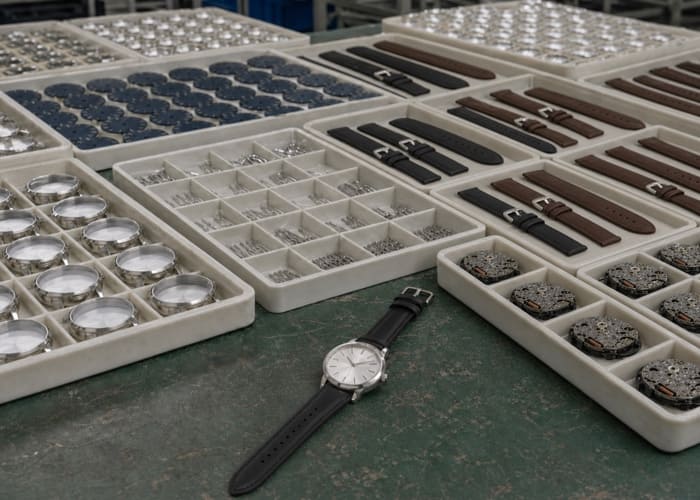
A watch manufacturer is, at its core, a master integrator. We don't produce every single part in-house. Instead, we manage a complex network of specialized suppliers who are experts in their respective fields: one factory for cases, another for dials, another for hands, and so on. Each of these suppliers has their own production constraints and their own MOQs. Our job is to coordinate them all for your project.
In my 15+ years in Shenzhen's watch industry, I've seen that these numbers are a matter of physics and finance. Setting up machinery for a production run carries a fixed cost, whether you're making 50 units or 500.
Component Suppliers and Their MOQs
The final MOQ we quote you is a direct result of the minimums we must meet with our partners.
- Watch Cases: This is often the most significant factor. Crafting a custom watch case involves creating molds or tooling, followed by precise CNC machining, polishing, and finishing.2 A case factory needs to produce at least 300–500 units of the same design to justify the machine setup time and cost.
- Dials: Dial manufacturing is a delicate, multi-step art.3 It involves stamping the brass blank, applying colors, printing text and markers, and applying luminous material. Each step requires its own setup. A dial supplier’s MOQ is often 500 pieces or more, but we can usually negotiate to split this into several color variations for a single order.
- Hands & Straps: Hand sets are stamped and finished in large batches. For straps, the MOQ depends on the material. A leather strap supplier might allow for a few hundred units split across different colors, while a custom-molded rubber strap or a unique stainless steel bracelet will have a higher tooling cost and MOQ, similar to the case.
Production Line Efficiency
Beyond the components, there's the assembly line itself. Setting up a dedicated line for a new watch model involves training assemblers, calibrating testing equipment (like water resistance testers), and implementing quality control checkpoints. Spreading these fixed setup costs over a larger number of units makes the per-unit cost viable.
| Order Quantity | Setup Cost per Unit | Assembly Cost per Unit | Final Cost per Unit |
|---|---|---|---|
| 50 Units | Extremely High | High | Prohibitively Expensive |
| 300 Units | Moderate | Optimal | Commercially Viable |
| 1000 Units | Low | Low | Very Efficient |
As you can see, the 300–500 unit range is the sweet spot where the cost becomes manageable for a new brand, and the production run is efficient enough for the factory.
How is a 'Model' Defined for Watch MOQ?
The thought of ordering 300 pieces of every single design variation is enough to stop a new brand in its tracks. You're worried your first collection will be monotonous, with no variety to offer customers. The good news is, a single MOQ order offers far more flexibility than you might think.
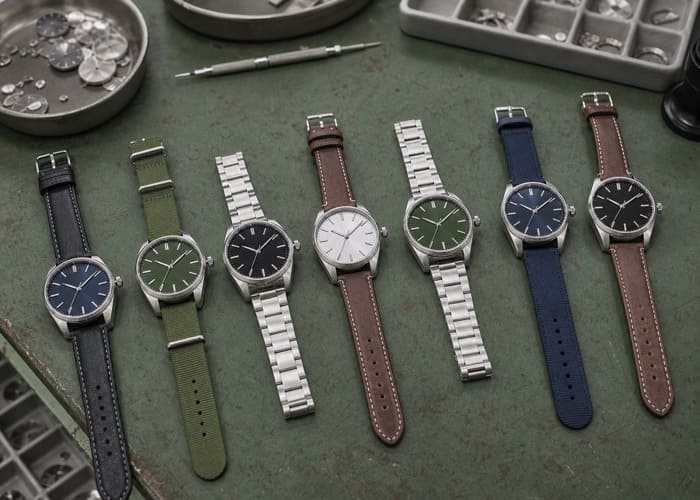
For the purpose of meeting a watch MOQ, a "model" is primarily defined by two core components that cannot be changed: the watch case and the movement. Within a single 300- to 500-piece order for one model, you can introduce significant variety through different dial colors, hand finishes, and strap options.
The Core Components: Case and Movement
When we talk about a "model," we are talking about the foundational architecture of the watch. These two elements are locked in for the entire production run.
- The Watch Case: This is the non-negotiable anchor of your model. The case's shape, diameter, thickness, and lug design are determined by expensive tooling and machining setups. Therefore, all 300–500 units in your order must share the exact same case. While PVD coatings (like black or gold) can sometimes be split into smaller batches, the underlying stainless steel case must be identical.
- The Movement: The movement is the engine of your watch. Whether it's a Japanese Miyota quartz, a Seiko NH35 automatic, or a Swiss Ronda chronograph, it dictates the entire internal structure of the case, the dial feet positioning, and the hand stack height. You cannot mix a three-hand automatic and a chronograph movement within the same "model" order, as they require completely different cases and dials.
Where You Get Creative Flexibility
This is where planning your collection gets exciting. Once the core model is defined, you can create several distinct SKUs (Stock Keeping Units) from a single production order. Based on my experience with hundreds of brands, here's how it works:
- Dials: This is your greatest tool for variation. For a standard 300-piece watch MOQ, we can almost always split the production into 3 different dial colors. For a 500-piece order, you can often go up to 5 colors.
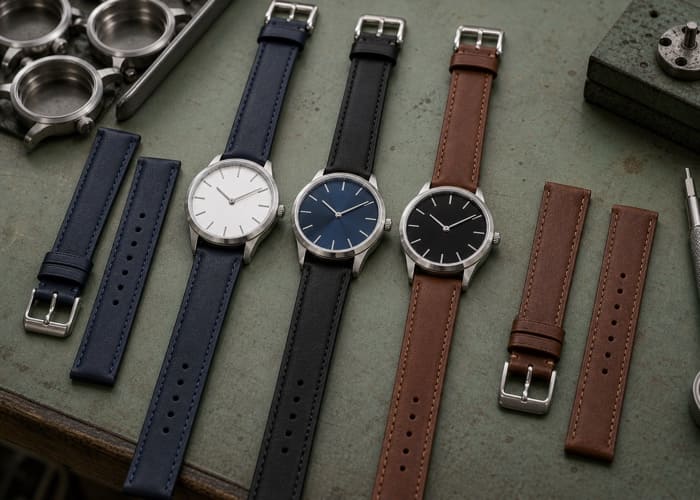
- Straps: If your design uses leather or fabric straps, the flexibility is enormous. You can easily pair different strap colors with different dials to create unique combinations. For example, a blue dial could be offered with both a brown leather strap and a blue one.
- Hands: While less common, it's sometimes possible to vary the finish of the hands (e.g., polished vs. brushed) if the quantities for each variation are large enough, typically 150-200 units per style.
Let's walk through a practical example for a 300-piece MOQ:
- Core Model: 40mm 316L stainless steel case with a Seiko NH35 automatic movement.
- Your Order Breakdown: You decide to create three distinct SKUs.
- SKU 1 (100 units): Matte Black Dial + Brown Leather Strap
- SKU 2 (100 units): Sunray Blue Dial + Black Leather Strap
- SKU 3 (100 units): Classic White Dial + Blue Leather Strap
With just one production order, you've launched a collection with three unique products ready for market. This strategy allows you to test which colorways resonate most with your audience without over-investing in any single one.
Are There Exceptions to the Standard Watch MOQ?
What if 300 pieces is still too high a hurdle for your very first production run? You might be searching for a loophole or a special circumstance that allows for a smaller order. The answer is yes, exceptions exist, but they always come with important trade-offs to consider.
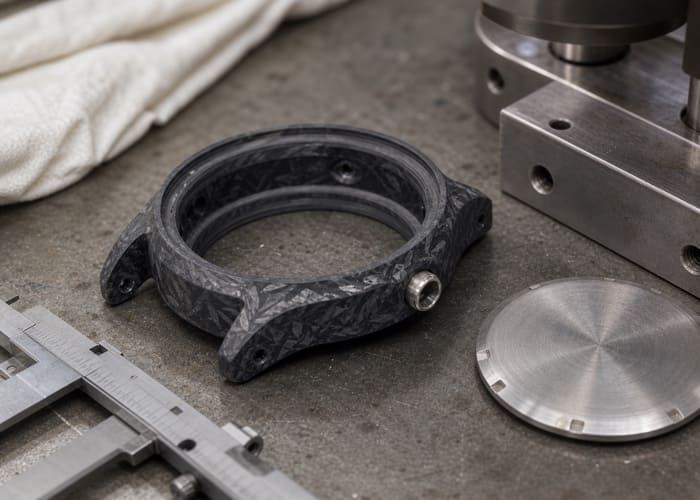
Yes, there are exceptions to the standard watch MOQ. The most common is choosing a pre-existing "stock" or "ODM" design from the factory, which can lower the minimum to 50-100 units. Another exception is for high-cost, complex models involving expensive materials like carbon fiber, where a 100-200 piece run may be feasible due to high upfront tooling investments.
The ODM / Stock Design Option
Many manufacturers, including Ohlala Watch, offer a catalog of pre-developed watch designs. This is known as ODM (Original Design Manufacturing).
- How it works: You browse our existing catalog of watch models for which we already have the molds and a streamlined supply chain. You select a design you like, and the only customization is typically adding your logo to the dial, case back, and crown.
- The MOQ: Because the engineering and tooling are already complete, and we often have components on hand, the MOQ can drop significantly to the 50-100 piece range.
- The Trade-off: The primary drawback is a lack of uniqueness. Other brands may be using the exact same case and design. This path is excellent for testing a market, validating a sales channel, or for corporate gifting, but it is less suitable for building a truly distinct, long-term brand identity.
High-Value Materials & Complex Tooling
The economics of manufacturing shift when dealing with very expensive or difficult-to-work-with materials.
I've worked on projects using forged carbon fiber, where the cost to create the initial case mold can be thousands of dollars. The raw material is also exceptionally pricey. In these scenarios, the bulk of the financial commitment, both for the client and for us, is in the tooling and setup.
Because the upfront investment is so high, we can sometimes greenlight a smaller production run of 100 or 200 pieces. The final per-unit cost will be very high, but it makes the project accessible to niche luxury brands. This can also apply to models with very complex, multi-part cases or unique materials like bronze that require special handling.
Building a Long-Term Partnership
Finally, business is about relationships. For a brand-new client, the MOQ is firm because we are establishing a new supply chain for you from scratch. However, for our repeat clients who have a proven track record of successful production runs and re-orders, we can sometimes offer more flexibility. If we have a strong, trusting partnership and know that a new model launch will likely lead to larger orders down the line, we might accommodate a slightly lower initial watch MOQ to help you expand your collection.
Frequently Asked Questions
Can I order just one single custom watch?
No, OEM/ODM manufacturing is exclusively for bulk production. The setup for a single piece is cost-prohibitive. For a one-off custom watch, you would need to work with a bespoke watchmaker or a "watch modder," not a factory.
Does the watch MOQ include the custom packaging?
Packaging is typically considered a separate item with its own MOQ. Box manufacturers have their own production minimums. We manage and coordinate the sourcing of custom boxes, manuals, and warranty cards for you, but they are quoted as a separate line item.
What happens if I can't meet the watch MOQ?
If the 300-500 piece MOQ is out of reach, your best options are to: 1) Explore the ODM/stock design route with a 50-100 piece MOQ. 2) Find a partner to co-invest and split the order. 3) Continue to save capital until you can comfortably afford the minimum order for your unique design.
Is the MOQ for re-orders the same?
Generally, yes. The MOQs from our component suppliers do not change for re-orders. However, because the tooling is already created and the supply chain is established, the process is much smoother and faster. For long-term partners, we can sometimes offer minor flexibility on re-orders.
Conclusion
Navigating the world of watch manufacturing means understanding its core principles, and the watch MOQ is one of the most important. The standard of 300–500 units for a custom OEM project isn't an arbitrary barrier; it’s a number dictated by the real-world economics of the component supply chain and efficient assembly. By understanding that a "model" is defined by its case and movement, you can strategically use dial and strap variations to create a diverse collection from a single order. For those just starting, ODM options provide a lower-risk entry point to the market.
Planning your first watch collection is a complex but rewarding process. A clear grasp of the watch MOQ is your first major step toward success. If you're ready to move from concept to creation, our team at Ohlala Watch is here to guide you.
Ready to discuss your watch project? Contact us at debbie.p@ohlalawatch.com or visit our contact page to start the conversation.
"Everything You Need to Know About Watch Minimum Order Quantities", https://www.naviforce.com/news/everything-you-need-to-know-about-watch-minimum-order-quantities/. Studies on manufacturing economics often highlight that minimum order quantities are set to offset fixed costs like tooling and setup, making production viable for factories. For watches, industry reports suggest 300-500 units as a common threshold for custom designs due to these constraints. Evidence role: general_support; source type: research. Supports: The economic feasibility of 300-500 units as a standard MOQ for custom watch manufacturing.. Scope note: Specific numbers may vary by region and factory capabilities. ↩
"CNC milling a watch case? : r/WatchHorology", https://www.reddit.com/r/WatchHorology/comments/w7pzdd/cnc_milling_a_watch_case/. Educational resources on watchmaking confirm that custom watch cases require molds, CNC machining, polishing, and finishing as standard steps in production. Evidence role: mechanism; source type: education. Supports: The detailed process of crafting a custom watch case.. Scope note: Specific processes may vary depending on the material and design complexity. ↩
"Making a watch dial explained by Jeff Kingston - YouTube",
. Educational resources on horology describe dial manufacturing as involving stamping, coloring, printing, and luminous material application, confirming the complexity of the process. Evidence role: mechanism; source type: education. Supports: The multi-step process involved in watch dial manufacturing.. Scope note: Specific techniques may differ based on the manufacturer and design requirements. ↩