
Выпуск новой коллекции часов подводит вас к критической развилке пути.. По одному пути, there's the speed of buying ready-made stock; on the other, the creative control of building from scratch. The dilemma of wholesale vs custom watches can be paralyzing, as one route promises immediate inventory while the other offers a unique identity. Making the right choice is the first step toward building a profitable and sustainable watch brand.
Wholesale watches involve purchasing existing, often unbranded or pre-branded, watches in bulk for direct resale. In contrast, custom watches (ОЭМ/ОДМ) involve partnering with a manufacturer to design and produce a unique timepiece from the ground up, tailored to your brand’s exact specifications. The best choice depends on your business model, бюджет, фирменный стиль, and long-term goals.
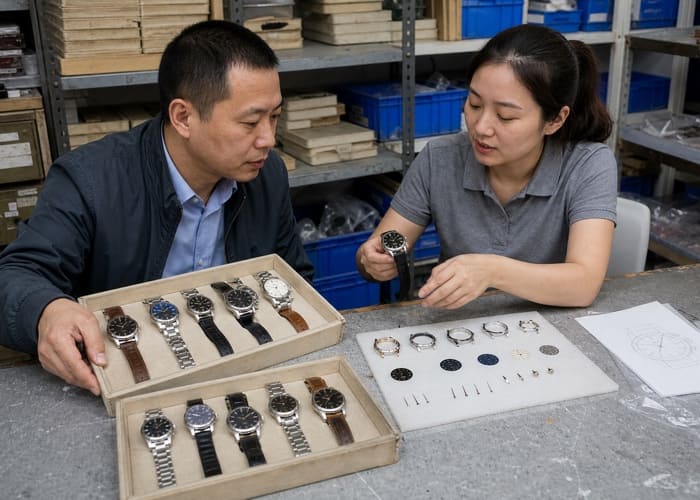
Now that we’ve clarified the basic distinction, how do you know which path is for you? Let's dive deeper into the critical factors—cost, фирменный стиль, and supply chain management—that separate these two approaches. This will help you determine the most strategic route for your business.
When Comparing Wholesale vs Custom Watches, What Are the Real Costs?
Are you worried about the financial commitment of starting your watch line? The low per-unit price of a wholesale watch can be tempting, but hidden costs often lurk beneath the surface.1 Customization might seem expensive upfront, but it could provide far greater value and profitability in the long run.
The primary financial difference is simple: wholesale has a lower barrier to entry but often yields lower margins, while custom manufacturing requires a higher initial investment for a unique asset with greater profit potential.
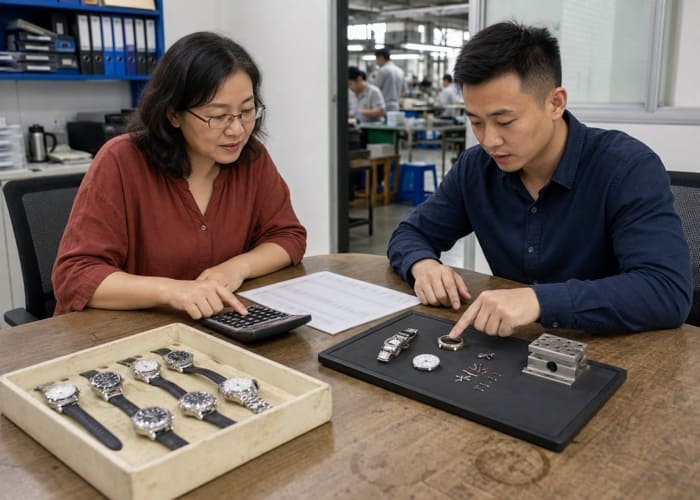
The Upfront Cost of Wholesale Watches
The main appeal of wholesaling is the low upfront cost. You can buy watches on a per-unit basis without committing to large volumes, оснастка, or development fees. Однако, it's crucial to understand what you are buying.
В моем 15+ years in the Shenzhen watch industry, I've seen a clear pattern. The vast majority of readily available wholesale watches fall into two categories:
- Overstock from other brands: These carry another company's branding.
- Cheap, unbranded alloy watches: These are produced with low-cost materials to be as inexpensive as possible.
You will find very few unbranded, high-quality stainless steel watches available for wholesale. Why? Because the cost of the material is significant. For a factory, producing thousands of stainless steel watches without a committed buyer and holding them as inventory is a huge financial risk. Alloy is cheaper, so it dominates the low-end wholesale market.
Beyond the unit price, consider these hidden costs:
- Re-packaging: Generic packaging won't reflect your brand and will likely need to be replaced.
- Marketing Challenges: You have to spend more on marketing to differentiate a product that your competitors can also sell.
- Quality Issues: Without control over the production process, you may face a higher rate of defects, which eats into your profits.
The Investment in Custom Watch Manufacturing
Choosing custom manufacturing means you are not just buying a product; you are investing in creating a unique brand asset. The costs are more structured and transparent, but the initial financial outlay is higher.
Here’s a typical breakdown of costs for an OEM (Original Equipment Manufacturer) project:
- Tooling/Mold Fees: If your design requires a unique case, набирать номер, or other components, a new mold must be created. This is a one-time investment that can range from a few hundred to several thousand dollars, depending on complexity.
- Sampling Costs: Before mass production, we create prototypes for your approval. This ensures the final product matches your vision perfectly.
- Минимальное количество заказа (минимальный заказ): This is the biggest financial hurdle for most new brands. To make production viable, manufacturers require a minimum order, typically between 300 и 500 куски за модель. This ensures we can source components cost-effectively and set up the assembly line efficiently.
While the total invoice for a custom order is significantly larger than a small wholesale purchase, the long-term ROI is where it shines. You gain complete control over:
- Материалы: Choose 316L stainless steel over cheap alloy, and sapphire crystal over mineral glass.
- Движение: Select a reliable Japanese Miyota or a premium Swiss Sellita movement.
- Брендинг: Your brand is integrated into the design, from the dial and caseback to the crown and buckle.
This investment builds a product with higher perceived value, justifying a higher retail price and fostering true brand loyalty.
| Особенность | Wholesale Watches | Обычай (ОЭМ/ОДМ) Часы |
|---|---|---|
| Upfront Cost | Low per unit | Высокий (минимальный заказ, Оснастка, Образцы) |
| Product Type | Generic, often alloy material | Unique, specified materials (например, 316L Steel) |
| Brand Control | Minimal to none | Full control over design & брендинг |
| Barrier to Entry | Низкий | Высокий |
| Profit Margin | Lower | Potentially Higher |
| Brand Equity | Низкий | Высокий |
How Does the Wholesale vs Custom Watches Debate Impact Brand Identity?
You’ve poured time and energy into cultivating a unique brand story and aesthetic. Does selling a generic, off-the-shelf product risk diluting your message? Or is speed-to-market the most critical factor for you right now? The answer will define your brand's position in the market.
Wholesale offers speed but forces your brand into a sea of sameness, as competitors can sell the exact same product. Custom watch manufacturing allows you to embed your brand's DNA into every component, creating a unique and defensible product that builds lasting brand equity.
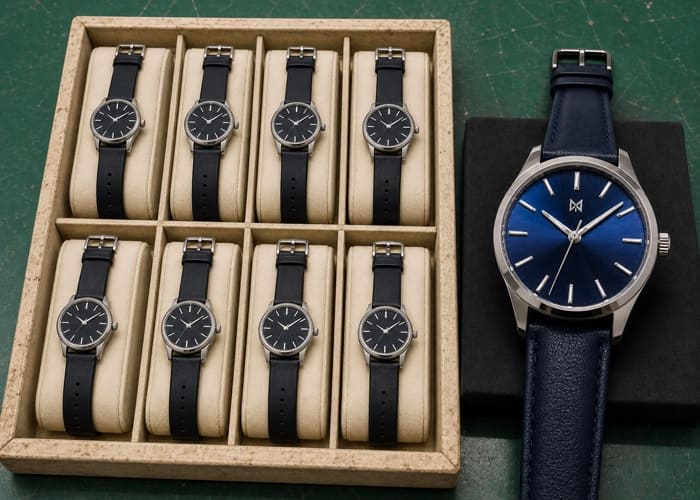
The Generic Nature of Wholesale
When you buy from a wholesale catalog, you're buying a commodity. The same factory that sold those watches to you is also selling them to countless others on platforms like Amazon, Shopify, and Alibaba. This creates a direct race to the bottom on price.
This is especially true for "private label" часы, which are often just stock wholesale models with a logo printed on the dial. This superficial customization does little to hide the fact that the core product is generic. If your brand is built on uniqueness, craftsmanship, or a specific story, selling a generic product creates a disconnect that customers will notice. Your brand becomes about finding the cheapest supplier, not about delivering a unique vision.
I've seen many promising brands falter because they started with wholesale. They built an audience with great marketing, but their product couldn't back it up. Customers would leave reviews saying, "I saw the same watch on another site for less." That's a death sentence for a young brand.
Building an Asset with Custom Manufacturing
A custom-made watch is more than a product; it's the physical embodiment of your brand. The OEM/ODM process gives you a blank canvas to create something that is exclusively yours.
Consider the possibilities:
- А minimalist brand can specify a slender 36mm case, a clean, marker-less dial, and a specific Pantone color for the second hand.
- А robust sports watch brand can demand a 42mm case with 20 ATM water resistance, a screw-down crown, luminous C3 Super-LumiNova markers, and a custom-molded rubber strap.
- А fashion-forward brand can experiment with unique case shapes, intricate dial textures, and trendy strap materials that align with upcoming seasonal collections.
Every decision—from the font on the dial to the finishing on the case (матовый, полированный, or sandblasted)—reinforces your brand identity. When a customer holds your watch, they are holding a piece of your story. This creates a powerful connection that a generic product can never replicate. It transforms your product from a disposable item into a collectible asset, building a foundation for long-term success in the debate of wholesale vs custom watches.
What Are the Supply Chain Differences in Wholesale vs Custom Watches?
Navigating international supply chains can feel daunting. Are you simply placing an order and hoping for the best, or are you actively managing a complex development project? Understanding the process for each approach is essential for avoiding costly delays and disappointment.
The wholesale supply chain is transactional: you order existing stock, and it ships. The custom watch manufacturing process, однако, is a collaborative project that involves detailed design confirmation, прототипирование, редакции, and phased mass production, requiring a close partnership with your manufacturer.
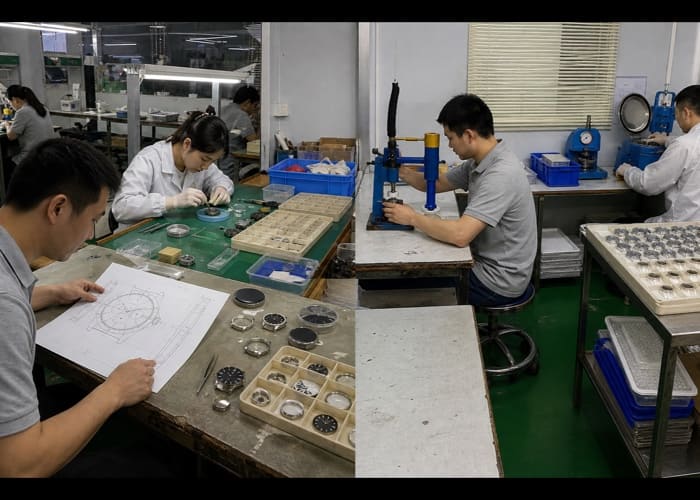
The Simplicity (and Risk) of the Wholesale Process
The wholesale process appears straightforward on the surface:
- Find a supplier, often through a large B2B marketplace.
- Browse their catalog of existing watches.
- Place an order and submit payment.
- Wait for the goods to arrive.
The simplicity is appealing, but it comes with significant risks. You have almost zero visibility into the supply chain or quality control. The product photos may look great, but you have no guarantee that the batch you receive will meet that standard. There is often little recourse if you discover quality issues upon arrival. In this model, you are simply a customer making a one-time purchase, not a partner in a production process.
The Collaborative Nature of the OEM/ODM Process
Custom manufacturing is a partnership from day one. At Ohlala Watch, we guide our clients through a structured, transparent process designed to eliminate surprises and ensure the final product is perfect. This is how we de-risk the investment in creating a custom watch line.
Our standard OEM process unfolds in clear stages:
- Дизайн & Консультация: You bring us your vision—sketches, вдохновение, or technical requirements. We provide expert feedback based on manufacturability and cost, helping you refine your concept.
- 2D Technical Drawings: We translate your design into precise engineering drawings. Every dimension, материал, and finish is specified. You approve these drawings before any physical work begins.
- Выборка (30–90 days): We produce a physical prototype based on the approved drawings. This is the most exciting stage, as you get to hold your watch for the first time. You can test its fit, чувствовать, and function.
- Revisions: Based on your feedback on the sample, we make any necessary adjustments. We don't move forward until you are 100% satisfied.
- Массовое производство (45–60 days): With the final sample approved, we begin full production. Our process includes rigorous Контроль качества at every step:
- Входной контроль: We verify every component—cases, движения, dials, руки, and straps—from our suppliers.
- Текущий контроль: Our assembly team checks for quality during each stage of production.
- Functional Testing: Every watch is tested, including water resistance tests according to your product's specifications (например, 5 банкомат, 10 банкомат).
- Заключительная проверка: A final quality check is performed on every single watch before it is packaged for shipment.
This collaborative journey ensures you are in full control and turns the complexity of the Shenzhen supply chain into your competitive advantage.
Часто задаваемые вопросы
What is the typical MOQ for custom watches?
The typical Minimum Order Quantity (минимальный заказ) for a custom watch model is between 300 к 500 куски. This number is necessary for our suppliers to achieve economies of scale when sourcing high-quality components like stainless steel cases and reliable movements, and it makes the production line setup cost-effective.
Can I put my logo on a wholesale watch?
Да, this service is often called "private labeling." Однако, it's a very basic level of customization where a logo is simply printed on a generic, pre-existing watch model. The underlying product remains a stock item that is likely available to your competitors from the same supplier.
Are custom watches more expensive than wholesale watches?
The initial investment for custom watches is higher due to one-time costs for tooling, samples, and the commitment to an MOQ. Однако, the per-unit cost for a high-quality, custom stainless steel watch is often very competitive. More importantly, the potential for higher retail margins and brand value is far greater.
Why are most wholesale watches made of alloy instead of stainless steel?
This is a purely economic decision. Stainless steel is a more expensive raw material. For a factory, manufacturing thousands of stainless steel watches without a confirmed buyer is a significant financial risk. Alloy is much cheaper, making it the go-to material for low-cost, mass-produced wholesale stock that can be sold with minimal risk.
How long does it take to develop a custom watch?
The entire process, from finalizing your design concept to receiving your mass-produced order, typically takes between 4 к 6 месяцы. This timeline includes about 30–90 days for the sampling and revision phase and another 45–60 days for mass production after the final sample is approved.
Заключение
Ultimately, the choice in the wholesale vs custom watches debate hinges on your long-term vision. Wholesale offers a low-cost, fast-track entry into the market, but it comes at the expense of brand identity, quality control, and long-term defensibility. Custom watch manufacturing, while a more significant initial investment, empowers you to create a unique, high-quality product that builds real brand equity, commands higher margins, and fosters customer loyalty. For serious entrepreneurs looking to build a lasting brand in the competitive watch market, the control and differentiation offered by the custom OEM/ODM route are not just beneficial—they are essential.
If you are ready to move beyond generic products and build a watch line that truly represents your brand's vision, we are here to guide you. Contact us at debbie.p@ohlalawatch.com or visit our страница контактов to discuss your project. Let's create something extraordinary together.
"Navigating the Challenges of Watches Wholesale Distributors", https://www.niferwatch.com/a-navigating-the-challenges-of-watches-wholesale-distributors.html. Research on wholesale business models identifies common hidden costs, such as repackaging, quality control, and marketing expenses, that can reduce profit margins. Доказательная роль: General_support; тип источника: исследовать. Поддерживает: The claim that wholesale watches may have hidden costs impacting profitability.. Примечание по объему: The findings may apply broadly to wholesale products and not exclusively to watches. ↩