The vision of launching your own watch brand often starts with a clear design idea, but quickly runs into the practical challenge of sourcing products. Without the right supply chain, that vision can stall, caught between the risk of low-quality goods and the complexity of manufacturing. Understanding how to find and purchase wholesale watches for resellers is the foundational step to turning your brand concept into a profitable reality.
To buy wholesale watches for resellers, you have two primary options. The first is to purchase existing, branded stock in smaller quantities (50-100 stykker) from large wholesale markets like those in Guangzhou. The second, more strategic path is to partner with an OEM/ODM manufacturer to create a unique, private-label watch collection, which typically requires a higher minimum order quantity (300-500 stykker).
Choosing between reselling someone else's brand and building your own is a critical decision that will define your brand's potential for growth, profitability, and long-term value. Let's explore these pathways so you can make the most informed choice for your business.
What Are the Main Ways to Source Wholesale Watches?
You've decided to enter the watch market, but the path forward seems to split in two. Do you buy and flip existing products, or do you create something entirely new? This choice is more than just a logistical detail; it's the very foundation of your business model. Knowing the pros and cons of each approach is essential before you invest your first dollar.
The two main strategies for sourcing wholesale watches are buying ready-made stock from distributors and creating your own custom line with an Original Equipment Manufacturer (OEM). The first is faster and requires less capital, while the second offers brand ownership and higher profit potential.
Dykk dypere: Distributor vs. Private Label
Making the right sourcing decision requires a clear understanding of what each path entails. I min 15+ years in the watch manufacturing industry, I've guided countless entrepreneurs through this exact choice. Let’s break down the two dominant models.
H3: The Distributor & Wholesale Market Model
This is often the first stop for new resellers. Cities like Guangzhou are famous for vast wholesale markets1 where you can find countless watch brands ready for purchase. You can act as a distributor or agent for these existing brands.
- How it works: You visit a market or contact a distributor, select from their current catalog, and purchase a small batch of watches, often as few as 50 eller 100 units. These watches already have a brand name, which may or may not be known in your target market. Your job is simply to resell them.
- Advantages:
- Low Minimum Order Quantity (MOQ): It's the most accessible entry point, minimizing your initial financial risk.
- Speed to Market: You can have products in hand and listed for sale within weeks.
- No Design Work: The product is already developed, saving you time and creative resources.
- Disadvantages:
- No Brand Equity: You are building someone else's brand, not your own. All your marketing efforts increase their brand value.
- Low Profit Margins: You're another link in the supply chain, and your margins will be squeezed by the brand owner and intense competition from other resellers selling the exact same product.
- Lack of Control: You have zero say over the design, quality, or future availability of the product. If the brand discontinues a popular model, you have no recourse.
H3: The Private Label (OEM/ODM) Model
This path is for brand builders. Instead of buying off-the-shelf products, you partner with a manufacturer like us at Ohlala Watch to create a unique watch collection under your own brand name. OEM (Originalt utstyrsprodusent) means we build your custom design, while ODM (Original designprodusent) means you modify one of our existing designs with your branding.
- How it works: You provide us with your design concepts, specifications, og merkevarebygging. We work with you to create technical drawings, produce samples for your approval, and then manufacture your exclusive watch line.
- Advantages:
- Total Brand Control: The brand is 100% yours. You own the design, the story, and the customer relationship. You are building a long-term asset.
- Higher Profit Margins: By going directly to the source, you eliminate middlemen. This allows for significantly healthier margins, even after accounting for marketing costs.
- Unique Market Position: Your product is exclusive to you. You don't have to compete on price against a dozen other resellers with the same watch.
- Disadvantages:
- Higher MOQ: Manufacturing requires a larger commitment, typically starting at 300-500 units per model.
- Longer Lead Time: The development process—from design to sampling to mass production—takes several months.
- Requires Initial Investment: You'll need to invest in design development (even if it's just your time) and sampling before placing a full production order.
H3: Sourcing Model Comparison
To make it even clearer, here is a direct comparison of the two models for sourcing wholesale watches for resellers.
| Trekk | Distributor / Wholesale Market | Private Label (OEM/ODM) Produsent |
|---|---|---|
| Brand Ownership | None (You resell an existing brand) | 100% Yours (You build your own asset) |
| Typisk MOQ | 50–100 stykker | 300–500 pieces |
| Fortjenestemargin | Lav | Høy |
| Design Control | None | Full |
| Tid til marked | Rask (Weeks) | Slower (Months for first run) |
| Competition | Very High (Direct product competitors) | Senke (Brand-level competition) |
| Best for | Markedstesting, quick cash flow | Building a long-term, sustainable brand |
How Do You Evaluate Suppliers of Wholesale Watches for Resellers?
Finding a potential supplier is one thing; vetting them is another. A wrong choice can lead to missed deadlines, inconsistent quality, and a damaged brand reputation before you even get started. The stakes are high, and a methodical evaluation is your best defense against a poor partnership.
To properly evaluate suppliers of wholesale watches for resellers, you must assess their communication, technical capabilities, documented quality control processes, and production terms like MOQ and lead times. A trustworthy partner will be transparent in all four areas.
Dykk dypere: The Supplier Vetting Checklist
As an OEM manufacturer, we are on the other side of this evaluation process every day. We know what separates a reliable partner from a risky one. Here are the key areas I advise all potential brand owners to scrutinize.
H3: Communication and Expertise
Before you talk about price, evaluate how they communicate. A good partner acts as a consultant, not just an order-taker.
- Responsiveness: How quickly and clearly do they answer your questions? Do they address all your points, or just the easy ones?
- Språk: Is there a language barrier? Clear communication is non-negotiable for conveying complex technical details. På Ohlala Watch, our team is fluent in English and dedicated to working with international clients.
- Industry Knowledge: Do they offer suggestions to improve your design for better durability or cost-effectiveness? For eksempel, can they explain the practical differences between a Miyota 9015 and a Seiko NH35A movement2? A partner with deep experience, like our 15+ years in Shenzhen's watch ecosystem, can prevent costly mistakes.
H3: Technical Capabilities and Materials
Your watch is only as good as the components it's made from. You need to verify that the supplier can source and work with the quality of materials you require.
- Movements: Do they offer a range of reputable movements? Ask specifically for brands like Miyota, Seiko, Ronda, and Sellita.
- Sak & Glass: Confirm they use industry-standard materials like 316L stainless steel for cases3 and can source both mineral and sapphire crystal for the glass. Sapphire is more scratch-resistant and a key selling point for premium watches.
- Customization Scope: How deep does their customization go? A good OEM partner can customize the dial, hender, sak, caseback, krone, stropp, og til og med emballasjen.
H3: Kvalitetskontroll (QC) and Compliance
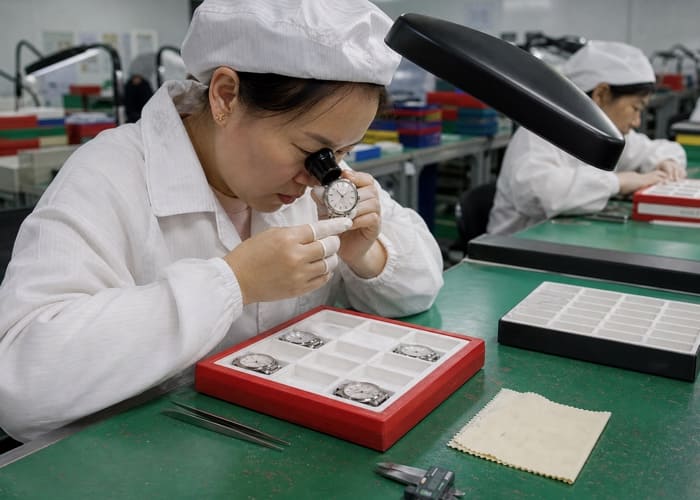
Never take a supplier's claim of "high quality" at face value. Ask for their QC process documentation. A professional manufacturer will have a multi-stage inspection protocol.
- Innkommende kvalitetskontroll (IQ): They should be inspecting all components—cases, bevegelser, ringer, straps—før monteringen begynner.
- Kvalitetskontroll under prosess (IPQC): Checks should be performed during assembly to catch errors early.
- Endelig kvalitetskontroll (FQC): Every finished watch must be inspected for cosmetic flaws, funksjon, and timekeeping accuracy.
- Specific Tests: Ask about their water resistance testing. Do they test 100% of watches rated 5 ATM or higher? How is the test conducted?
- Overholdelse: If you plan to sell in Europe, ask for evidence of CE and RoHS compliance4. Reputable suppliers serving the EU market will have this readily available. Buyers should always treat certifications as documents to be verified independently.
H3: Business Terms: MOQ and Lead Times
Finally, ensure their business terms align with your plan.
- Minimum bestillingsantall (MOQ): This is the minimum number of units you must order per model. For custom manufacturing, 300-500 pieces is a standard starting point. If a factory offers a significantly lower MOQ for a fully custom watch, be wary—they may be cutting corners on quality or materials to make it work.
- Eksempel på ledetid: Expect 30–90 days to receive your first prototype5. This timeline depends on the complexity of your design and component sourcing.
- Mass Production Lead Time: Etter at du har godkjent prøven, mass production typically takes another 45–60 days6. A reliable supplier will give you a clear and realistic timeline from the start.
What Is the Process for Buying Custom Wholesale Watches?
The idea of creating a custom product from scratch can feel overwhelming, especially compared to just picking a watch from a catalog. It seems like a process reserved for huge corporations with massive R&D departments. Imidlertid, a structured OEM process makes it accessible even for small and medium-sized brands.
The process for buying custom wholesale watches for resellers is a clear, five-step journey. It begins with your design concept, moves to technical drawing confirmation, then to physical sampling for approval, and finally culminates in mass production and delivery.
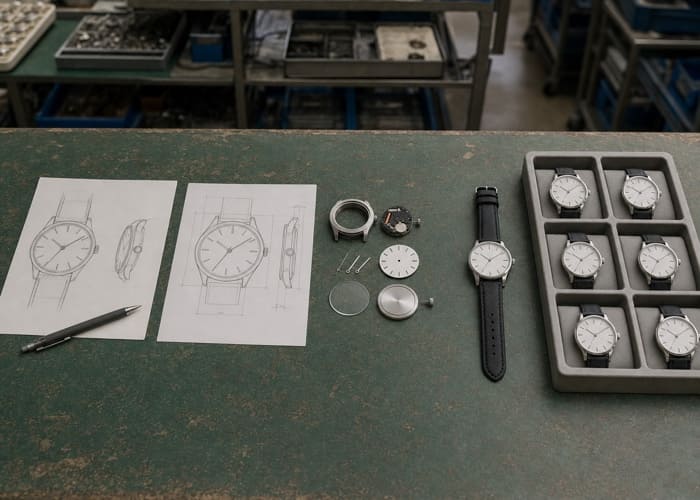
Dykk dypere: From Your Idea to a Finished Watch Collection
På Ohlala Watch, we've refined this process over thousands of projects. Our goal is to make it as transparent and straightforward as possible for our clients. Here’s a breakdown of what you can expect when you partner with an OEM manufacturer like us.
H3: Skritt 1: Design Consultation & Quoting
This is where your vision begins to take shape. You don't need to be a professional designer. You can come to us with:
- Mood boards or inspiration images.
- Sketches on a napkin.
- A detailed list of specifications (case size, materiale, bevegelsestype, osv.).
We will review your concept and provide initial feedback. Based on the complexity, materialer, and desired quantity, we will provide a preliminary quote for both the sample and the mass production run. This ensures you understand the cost structure before committing.
H3: Skritt 2: Technical Drawings (2D Renderings)
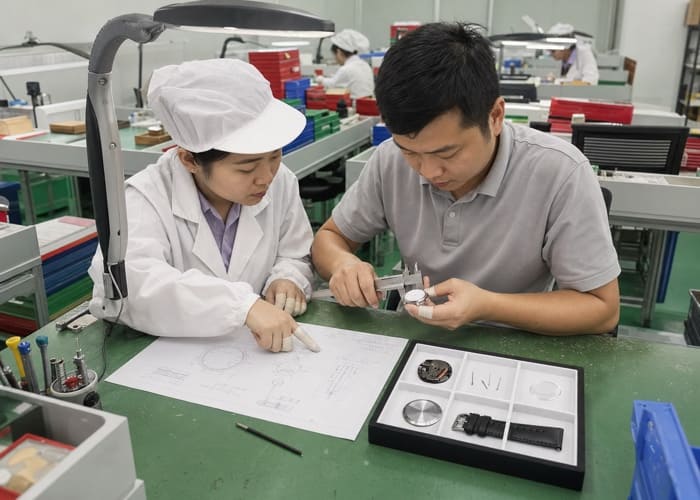
Once you approve the quote, our engineers translate your creative vision into a precise technical blueprint. This 2D drawing includes every specification, from the exact diameter of the case and thickness of the hands to the placement of your logo.
This is a critical checkpoint. You review the drawings and have the opportunity to make adjustments. Nothing moves to production until you have signed off on these technical drawings. This step prevents misunderstandings and ensures the final product will match your expectations.
H3: Skritt 3: Prototyping (Prøvetaking)
With the approved drawings, we begin creating the physical sample. This involves sourcing all the individual components and assembling one or more complete watches. The sample is your opportunity to see, føle, and test your product in the real world. You can check the weight, the finish, the color, and the overall feel on the wrist.
I always tell my clients that the sample is the most important part of the entire process. It’s the ultimate quality check before you commit to a full production run.
H3: Skritt 4: Eksempel gjennomgang & Revisjoner
We ship the completed sample to you for final approval. In most cases, the sample is perfect and approved immediately. Imidlertid, sometimes minor adjustments are needed. Perhaps you want to try a different strap finish or adjust the color of the dial slightly. We will incorporate your feedback, make the necessary revisions, and if needed, produce a second sample until it's exactly right.
H3: Skritt 5: Masseproduksjon & Kvalitetskontroll
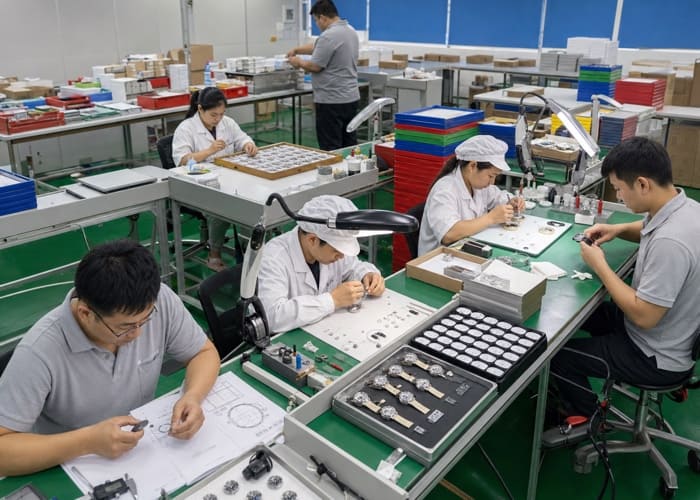
Once you give your final approval on the sample, we begin mass production. Our team in Shenzhen leverages a well-established supply chain to manufacture your order efficiently. Throughout this stage, our multi-step QC process is in full effect: we inspect incoming components, monitor the assembly line, and perform final checks on every single watch before it is packaged for shipment. This rigorous process ensures consistency and quality across your entire batch of wholesale watches for resellers.
Ofte stilte spørsmål
What is the typical MOQ for wholesale watches?
For off-the-shelf watches from wholesale markets, the MOQ can be as low as 50-100 units. For custom-designed private label watches via an OEM manufacturer like us, the MOQ is typically between 300 og 500 stykker per modell. This higher quantity is necessary to cover the costs of custom tooling, component sourcing, and production line setup.
Can I put my own logo on wholesale watches?
Ja, but the method differs. With stock watches, you can often pay a small fee to have your logo printed on the dial or engraved on the caseback. Imidlertid, with the OEM/ODM private label model, your logo is an integral part of the design from the very beginning, applied to the dial, krone, caseback, and buckle for a fully branded product.
How much does it cost to start a private label watch brand?
The cost varies widely based on your choices. Key factors include the movement (Japanese quartz is more affordable than Swiss automatic7), the crystal (mineral glass vs. safir), case materials, and order quantity. A typical first order for 300-500 watches can range from a few thousand to tens of thousands of dollars, plus sampling fees.
What are OEM and ODM watches?
OEM stands for Original Equipment Manufacturer. This is when we manufacture a watch based on your unique, original design. ODM stands for Original Design Manufacturer. This is when you select a pre-existing design from our catalog and we customize it with your logo, colors, og materialer. ODM is a faster, lower-cost way to get a custom look.
Konklusjon
Successfully sourcing wholesale watches for resellers boils down to a strategic choice: do you want to be a retailer or a brand owner? Reselling existing watches from wholesale markets offers a fast, low-risk entry into the market, but at the cost of brand control and profit margins. For those with a long-term vision, partnering with an OEM/ODM manufacturer to create a private label collection is the superior path. It allows you to build a unique brand, control your quality, and capture significantly more value. This is how you move from simply selling watches to building a lasting asset.
If you are ready to build a watch brand that is truly your own, my team and I are here to guide you through every step of the process.
Ready to create your own watch collection? Contact us today for a free consultation or reach out to me directly at debbie.p@ohlalawatch.com to discuss your project.
"Wholesale Watch Markets in Guangzhou: Complete China Guide", https://www.leitzeit.com/blog/automatic-watches-6/wholesale-watch-markets-in-guangzhou-a-complete-guide-286. Guangzhou is widely recognized as a significant hub for wholesale watch markets, hosting numerous distributors and manufacturers. This prominence is supported by its role in China's broader manufacturing and export economy. Bevis rolle: generell_støtte; kildetype: leksikon. Støtter: Guangzhou's reputation as a major hub for wholesale watch markets.. Omfangsnotat: The source may focus on general wholesale activity in Guangzhou rather than exclusively on watches. ↩
"NH35 VS Miyota 8215.... Does the Miyota have something ...", https://www.reddit.com/r/watchmaking/comments/j995z9/nh35_vs_miyota_8215_does_the_miyota_have/. The Miyota 9015 is known for its high beat rate and slim profile, making it suitable for thinner watches, while the Seiko NH35A is valued for its robustness and affordability. Bevis rolle: mekanisme; kildetype: forske. Støtter: The practical differences between Miyota 9015 and Seiko NH35A watch movements.. Omfangsnotat: The comparison may vary depending on specific use cases or watch designs. ↩
"The advantages of stainless steel watches", https://www.timepiecebank.com/fr/blog/advantages-of-stainless-steel-watches. 316L stainless steel is widely used in watchmaking for its high resistance to corrosion, hypoallergenic properties, and ability to maintain a polished finish. Bevis rolle: generell_støtte; kildetype: utdannelse. Støtter: 316L stainless steel is a standard material for watch cases due to its durability and corrosion resistance.. ↩
"RoHS", https://en.wikipedia.org/wiki/RoHS. CE marking indicates conformity with EU safety, health, og miljøvernstandarder, while RoHS compliance ensures restricted use of hazardous substances in electronic products. Bevis rolle: statistikk; kildetype: regjering. Støtter: CE and RoHS compliance are required for selling watches in Europe.. Omfangsnotat: The source may not specify how these regulations apply uniquely to watches. ↩
"Designing A Watch & Building Prototypes — How To Start ...", https://medium.com/rssdvs/designing-a-watch-building-prototypes-how-to-start-a-watch-brand-905a84df1453. The timeline for creating a watch prototype can range from 30 til 90 dager, depending on design complexity and component availability. Bevis rolle: statistikk; kildetype: forske. Støtter: The typical timeline for receiving a watch prototype from an OEM manufacturer.. Omfangsnotat: The timeline may vary significantly based on the manufacturer's capabilities and project specifics. ↩
"Manufacturing Process - OEM Watches China", https://customwatchfactory.com/manufacturing-process/. Mass production of watches generally takes 45 til 60 days after sample approval, depending on order size and manufacturing complexity. Bevis rolle: statistikk; kildetype: forske. Støtter: The typical timeline for mass production of watches after sample approval.. Omfangsnotat: The timeline may vary based on the manufacturer's capacity and supply chain efficiency. ↩
"[Discussion] Japanese vs Swiss movements on mechanical watches", https://www.reddit.com/r/Watches/comments/1793qbs/discussion_japanese_vs_swiss_movements_on/. Japanese quartz movements are typically less expensive than Swiss automatic movements due to differences in manufacturing complexity and labor costs. Bevis rolle: statistikk; kildetype: forske. Støtter: Japanese quartz movements are generally more affordable than Swiss automatic movements.. Omfangsnotat: The cost difference may vary depending on the specific brands and models compared. ↩