
Struggling to find a reliable watch manufacturer in China? You get quotes that are all over the place, making it impossible to compare them and leaving you worried about hidden costs.
The best way to find a reliable OEM/ODM watch manufacturer is to look beyond the unit price1. A good partner will help you clarify specifications, balance design with production reality2, and manage the entire project to reduce risk, not just give you the cheapest quote on paper.
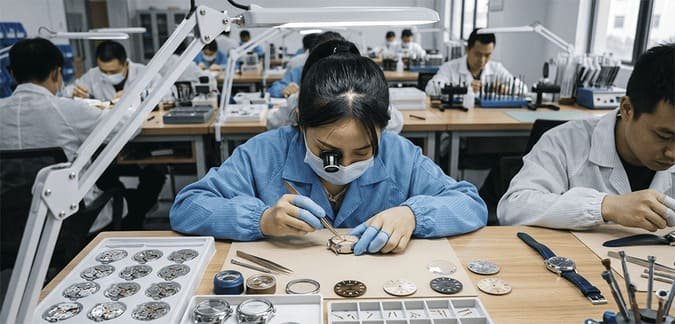
Many brand founders we talk to think that ordering custom watches is as simple as adding a logo to a catalog model. But when you want to build a real brand, de details are what matter3. The initial price you see often hides a lot of assumptions. Let's break down where the real costs, risks, and opportunities are hidden, so you can make a smarter choice.
Why Do Watch Quotes Vary So Much?
You've sent your watch design to five different suppliers and received five wildly different prices. It’s confusing, and you suspect that you aren't getting the full story from everyone.
Quotes vary because suppliers make different assumptions about your watch's components4. A low price might be based on a cheap Chinese movement and a PU leather strap, while a higher one assumes a quality Japanese movement and genuine leather. Without clear specifications, you can't compare them fairly.
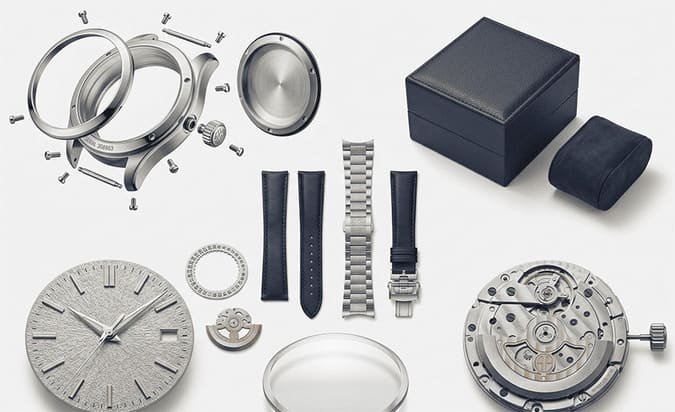
When we receive an inquiry without detailed specs, we have to make an educated guess. But a professional manufacturer should always come back to you with questions to clarify these points. The price of a watch is built from the ground up, and every single component choice matters. Till exempel, some factories in the Xixiang area of Shenzhen specialize in lower-cost alloy cases, while manufacturers in other districts focus on higher-end stainless steel production. These are completely different products.
To show you what this means in practice, here’s a comparison of how two quotes for the same design could be built on different assumptions:
| Komponent | Quote A (Lower Price) | Quote B (Higher Price) |
|---|---|---|
| Rörelse | Chinese Quartz5 | Japanese Miyota, Seiko or swiss Ronda Quartz |
| Material för fodral | Zinklegering | 316L or 304 Rostfritt stål6 |
| Plating | Water Plating (less durable)7 | IP or PVD Plating (durable) or DLC8 |
| Rem | PU Leather or folded Stainless bracelet | Genuine Calfskin Leather or Solid Stainless |
| Ringa | Simple Silk-Screen Print | Applied Metal Indices (or UP) |
| Värld | No Luminous Paint | Japan eller Schweiz Super-LumiNova®9 |
| Avsluta | Normal Finish | Fine Finish |
| Förpackning | thin Paper Box | Thicker paper box or Pu Box |
Som du kan se, both quotes are for a "watch," but they describe two completely different products in terms of quality, varaktighet, and brand feel. A low price isn't a good deal if it’s for a product that doesn't meet your quality standards. if they mentioned the material as " Metal", then they are hidden cost.
Is a Low MOQ Always the Best Choice for a New Brand?
As a new brand, you need a low Minimum Order Quantity (MOQ) to manage cash flow and test the market10. But you worry this means you'll have to accept lower quality or give up on your unique design vision.
A low MOQ is great for starting, but it often limits your customization options. Key suppliers for parts like cases or dials have their own high MOQs for creating new molds. The secret is finding a manufacturer who can guide you on what’s possible within a smaller production run.
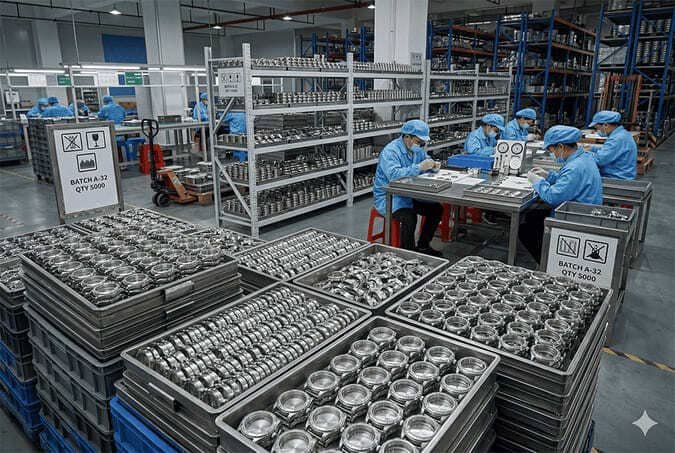
We work with brand founders on this issue all the time. The reality of watch manufacturing is that we rely on a whole supply chain. The factory that makes your custom case hands has a minimum, the dial maker has one, and the strap supplier has one, too. Our job is to coordinate all these suppliers for your project.
Till exempel, we recently worked with a European brand that wanted a unique, angular case shape for their first collection, with an MOQ of 300 bitar. The problem was that creating a brand-new mold11 for this case required a 1000-piece commitment from the case supplier. This is a common challenge. Instead of just saying "no," we worked with them to find a solution. We looked through our existing network of case suppliers and found a similar case shape that we could modify. By changing the finish from polished to brushed and designing a unique engraved caseback, the client achieved a custom look without the high cost and MOQ of a new mold. This kind of problem-solving is what a true partner does. It's about finding a balance between your vision and what's feasible for a small batch.
What Should You Look for Besides the Price Tag?
You've narrowed your list down to a few factories that fit your budget. Now you have to make the final call, but you're not sure what other questions you should be asking to avoid a mistake.
Look for a project partner, inte bara en ordertagare. Ask about their quality control process, their communication style during production, and if they provide design feedback. A reliable factory helps you prevent problems before they even start, protecting your investment and your brand's reputation.
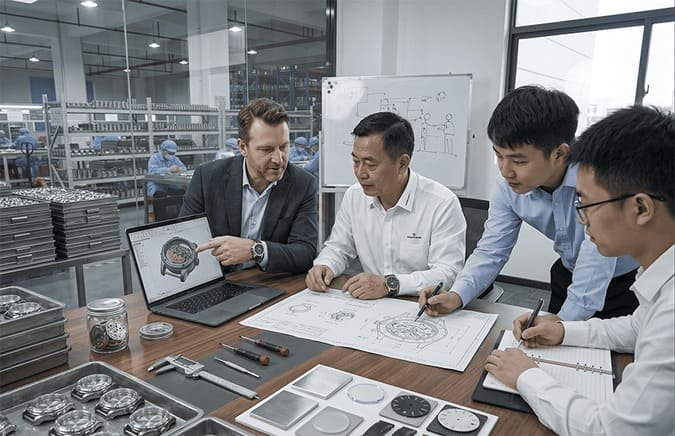
A good manufacturer should ask du as many questions as you ask them. They should be curious about your brand, your target market, and your quality expectations. Their goal is to make sure what they produce is exactly what you need. Here are the key areas you should dig into beyond the price.
Communication and Design Feedback
From the very first email, pay attention to how they communicate. Do they just give you a price, or do they review your design and point out potential manufacturing challenges? Till exempel, if you designed very thin hands with luminous paint, a good partner would warn you that the lume might be weak or uneven due to the small surface area. This proactive feedback is priceless because it saves you from producing a watch that disappoints your customers.
The Quality Control (QC) Behandla
You need to ask about their QC system. A professional factory will talk about their AQL (Acceptable Quality Limit12) standard. This is an industry method for inspecting a batch of products. They should have clear checks in place at three stages:
- Incoming Materials: Inspecting all components (fall, rörelser, remmar) before assembly begins.
- In-Process Assembly: Checking for issues like dust under the crystal or misaligned hands during the assembly process.
- Slutbesiktning: A full check of the finished watches for appearance, fungera, and water resistance before they are packed.
Transparency on All Costs
A trustworthy supplier is transparent from the start. Your quote should clearly separate costs for samples, massproduktion, and any one-time mold fees. Ask them directly: "Are there any other potential costs I should be aware of before we ship?" This includes things like packaging, frakt, or any specific certifications you might need. A hidden fee that pops up at the last minute is a major red flag.
Slutsats
Choosing the right OEM/ODM partner is about finding a team that manages risk and guides your project, not just the one that offers the lowest initial price.
"Analyzing Costs Using Total Cost of Ownership", https://psep.smeal.psu.edu/short-courses/supply-chain-accelerator/advanced-procurement-analyzing-costs-using-total-cost-of-ownership. Procurement guidance on total cost of ownership supports evaluating suppliers beyond the quoted unit price by considering lifecycle, transaction, kvalitet, and risk-related costs; this is general purchasing guidance rather than watch-specific evidence. Bevis roll: expert_konsensus; källtyp: institution. Stödjer: The best way to find a reliable OEM/ODM watch manufacturer is to look beyond the unit price.. Omfattningsanmärkning: The support is contextual because total-cost-of-ownership guidance applies broadly to procurement, not specifically to OEM/ODM watches. ↩
"[PDF] Product Design For Manufacture And Assembly - sciphilconf ...", https://sciphilconf.berkeley.edu/default.aspx/mL5E5B/602738/Product%20Design%20For%20Manufacture%20And%20Assembly.pdf. Design-for-manufacturing literature supports the principle that product designs should be reviewed against manufacturing constraints to reduce production problems; the source provides general manufacturing support rather than a watch-industry-specific rule. Bevis roll: expert_konsensus; källtyp: utbildning. Stödjer: A good OEM/ODM partner helps balance design ideas with production feasibility.. Omfattningsanmärkning: The evidence is contextual because design-for-manufacturing principles apply across manufactured products, not only watches. ↩
"[PDF] Manufacturing Process For Engineering Materials 6th Edition", https://sciphilconf.berkeley.edu/filedownload.ashx/mLA183/604912/manufacturing-process_for_engineering_materials-6th_edition.pdf. Research on product quality and design specifications supports that material, component, and process choices affect finished-product performance and perceived quality; it does not independently assess the specific watch examples in the article. Bevis roll: allmän_support; källtyp: papper. Stödjer: In custom watch manufacturing, small specification details materially affect the final product.. Omfattningsanmärkning: The support is broad and does not verify any single supplier’s quotation practices. ↩
"Cost modeling and design for manufacturing guidelines for ...", https://dspace.mit.edu/handle/1721.1/8138. Manufacturing cost-estimation literature shows that cost estimates depend on assumptions about materials, components, processes, och kvantiteter; this supports the explanation for quote variation but does not document the practices of individual watch suppliers. Bevis roll: mekanism; källtyp: papper. Stödjer: Supplier quotes can vary because they are based on different assumptions about components and specifications.. Omfattningsanmärkning: The evidence explains the general mechanism of cost-estimate variation, not a specific watch-factory quotation case. ↩
"Miyota (tillverkare av urverk) - Wikipedia", https://sv.wikipedia.org/wiki/Miyota_(watch_movement_manufacturer). Trade and horology reference sources distinguish quartz watch movements by manufacturer and country of origin, supporting that movement choice is a meaningful specification; such sources do not prove that all Chinese quartz movements are lower quality or lower cost. Bevis roll: definition; källtyp: encyklopedi. Stödjer: The movement type and origin are important watch specifications that can affect how quotes are constructed.. Omfattningsanmärkning: The evidence should support movement classification and specification relevance, not a blanket quality ranking by country. ↩
"The corrosion behaviour of AISI 304L AND 316L stainless steels ...", https://ui.adsabs.harvard.edu/abs/1997Corro..39..453O/abstract. Materials references describe 304 and 316L stainless steels as corrosion-resistant austenitic stainless steels, supporting their use as higher-specification case materials; the source would not by itself establish that every 316L or 304 watch case is superior in finishing or construction. Bevis roll: definition; källtyp: utbildning. Stödjer: 304 and 316L stainless steel are higher-specification case materials than generic low-cost metals in watch manufacturing.. Omfattningsanmärkning: The evidence supports material properties, not the overall quality of a particular watch case. ↩
"Comparison to Micro Wear Mechanism of PVD Chromium Coatings ...", https://pmc.ncbi.nlm.nih.gov/articles/PMC10096296/. Surface-engineering sources distinguish electroplating from vapor-deposition coatings and describe durability as dependent on coating method, tjocklek, adhesion, and substrate; this supports the need to verify plating method but does not prove that every water-plated watch finish is less durable. Bevis roll: mekanism; källtyp: papper. Stödjer: Different plating or coating processes can have different durability characteristics.. Omfattningsanmärkning: The support is contextual because coating durability depends on process parameters and testing conditions. ↩
"Biomedical applications of diamond-like carbon coatings: a review", https://pubmed.ncbi.nlm.nih.gov/17285609/. Materials-science literature describes PVD and DLC coatings as commonly used hard, wear-resistant surface coatings, supporting their characterization as durability-oriented finishes; it does not compare the exact coatings used by any watch supplier. Bevis roll: mekanism; källtyp: papper. Stödjer: PVD/IP and DLC coatings are used when greater surface durability or wear resistance is desired.. Omfattningsanmärkning: The evidence supports general coating properties, not a supplier-specific coating quality claim. ↩
"Strontium Aluminate-Based Long Afterglow PP Composites - PMC", https://pmc.ncbi.nlm.nih.gov/articles/PMC8122805/. Technical descriptions of photoluminescent pigments such as strontium aluminate explain their use in long-afterglow luminous applications, supporting the relevance of specifying a recognized luminous material; this does not verify the performance of any branded application on a particular dial or hand set. Bevis roll: definition; källtyp: forskning. Stödjer: The choice of luminous material is a specification that can affect a watch’s nighttime legibility and perceived quality.. Omfattningsanmärkning: The support concerns photoluminescent material properties generally, not a guarantee of performance in a finished watch. ↩
"what's next: robert swinney | Duke's Fuqua School of Business", https://www.fuqua.duke.edu/instagram-live-series/what-is-next-robert-swinney. Entrepreneurship and operations literature supports that smaller initial production runs can reduce inventory exposure and allow market testing; this evidence is general to new-product operations and not specific to watch brands. Bevis roll: allmän_support; källtyp: utbildning. Stödjer: New brands may prefer low MOQs to manage cash flow and test demand.. Omfattningsanmärkning: The support is contextual because it addresses startup inventory and market-testing principles rather than watch-industry MOQ norms. ↩
"[PDF] DEC 2 8 2009 - DSpace@MIT", https://dspace.mit.edu/bitstream/handle/1721.1/55230/611958280-MIT.pdf?sequence=2&isAllowed=y. Manufacturing references on tooling and injection or die tooling explain that custom molds require upfront tooling investment and are economical only over sufficient production volumes; this supports the MOQ constraint in principle, though not the specific 1,000-piece example. Bevis roll: mekanism; källtyp: utbildning. Stödjer: Custom molds can raise minimum-order requirements because tooling costs must be recovered across production volume.. Omfattningsanmärkning: The evidence supports the general economics of custom tooling, not the exact MOQ required by a watch case supplier. ↩
"american national standard sampling procedures and tables for ...", https://www.academia.edu/43049724/AMERICAN_NATIONAL_STANDARD_SAMPLING_PROCEDURES_AND_TABLES_FOR_INSPECTION_BY_ATTRIBUTES. ISO 2859-1 defines sampling procedures for inspection by attributes and uses acceptance quality limit terminology, supporting AQL as a recognized batch-inspection method; it does not prescribe the specific watch-factory checks listed in the article. Bevis roll: definition; källtyp: institution. Stödjer: AQL is an established method for inspecting batches of products.. Omfattningsanmärkning: The source supports the inspection framework, not the adequacy of any individual supplier’s QC system. ↩