
Je ne sais pas qui fabrique les montres MVMT? The "Made in China" l'étiquette ne raconte pas toute l'histoire. Je vais vous montrer le système derrière leur production massive.
Les montres MVMT sont fabriquées par plusieurs usines OEM en Chine, principalement à Shenzhen et Dongguan.1 Les commandes sont gérées par des sociétés commerciales basées à Hong Kong, qui se coordonnent avec ces fournisseurs spécialisés du continent. MVMT ne possède pas les usines; ils sous-traitent la production.
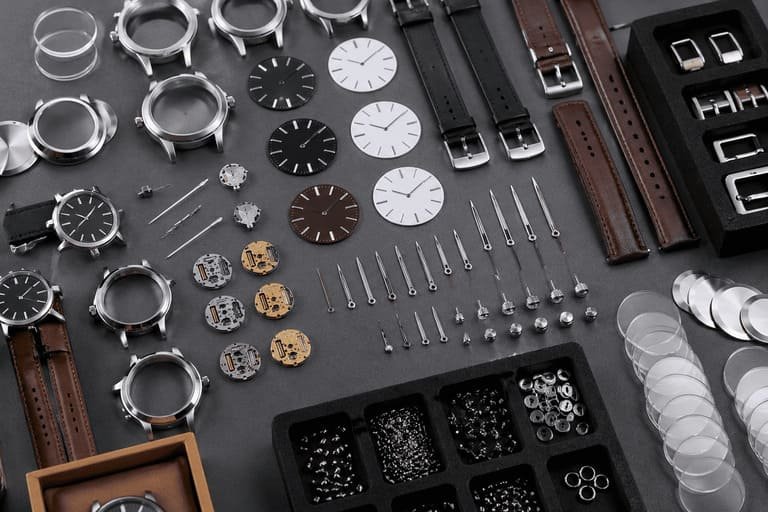
Ce modèle peut paraître compliqué, mais c'est la norme pour les grandes marques destinées directement au consommateur. C'est ainsi qu'ils atteignent leur taille tout en restant flexibles. Mais l'histoire devient plus intéressante quand on regarde les lieux spécifiques et les personnes impliquées.. Examinons plus en détail le fonctionnement réel de cette puissante chaîne d'approvisionnement..
Comment fonctionne réellement la chaîne d'approvisionnement MVMT?
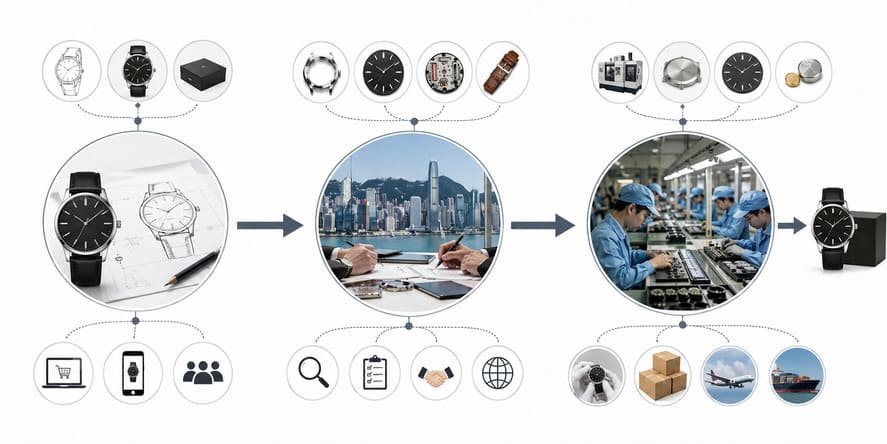
Vous êtes-vous déjà demandé comment un design devient une montre finie? Ce n'est pas une ligne directe. Le processus implique plusieurs acteurs, ce qui rend les choses complexes. Voici une répartition claire des rôles.
MVMT fournit des conceptions aux sociétés commerciales de Hong Kong. Ces entreprises agissent en tant que chefs de projet, s'approvisionner en composants et passer des commandes auprès d'usines en Chine continentale. Ils gèrent la logistique, communication, et paiements, créer un tampon entre la marque et les différents fabricants.

Le système est construit sur la spécialisation. MVMT se concentre sur le design, image de marque, et commercialisation. Ce sont des experts dans la vente de montres, je ne les fais pas. Ils confient leurs dossiers techniques à un partenaire expert en logistique de production: la société commerciale de Hong Kong.
Ces sociétés commerciales sont essentielles. Ils traduisent la vision de la marque en spécifications techniques que les usines peuvent comprendre. Ils gèrent également le côté financier, gérer les paiements et naviguer dans les règles du commerce international.
Ensuite, il y a les usines en Chine continentale. Ce sont les experts en production physique. Je connais ce système de première main car mon cousin travaillait au contrôle qualité pour une usine à Dongguan qui produisait des pièces pour MVMT..
Elle n'a jamais parlé directement avec quelqu'un de MVMT. Son interlocuteur a toujours été le chef de projet de la société commerciale de Hong Kong.. Ils ont fourni les listes de contrôle QC, échantillons approuvés, et géré l'intégralité de la commande. Cette approche à plusieurs niveaux est ce qui rend l’ensemble de l’opération si efficace.
Le rôle de chaque joueur
| Joueur | Responsabilité principale | Fonction clé |
|---|---|---|
| MVMT (La marque) | Conception, Commercialisation, Ventes | Crée l'identité de la marque et vend le produit final aux consommateurs. |
| Société commerciale de Hong Kong | Gestion de projet, Logistique | Agit comme intermédiaire, gérer la communication de l'usine, contrôle de qualité, et expédition. |
| Usine continentale | Fabrication, Assemblée | Produit physiquement les composants de la montre et assemble le produit final. |
Où se trouvent réellement les usines horlogères MVMT?
Is "Made in China" juste une étiquette générique? Pour les montres, il pointe vers des pôles d’expertise très spécifiques. Regardons les villes où se déroule le vrai travail.
Le cœur de la production horlogère de MVMT est concentré dans deux villes de la province chinoise du Guangdong: Shenzhen et Dongguan. Shenzhen est une plaque tournante des composants et de l'assemblage de haute technologie, tandis que Dongguan se spécialise dans la fabrication de boîtiers, polissage, et chaînes de montage à grande échelle.
Ces deux villes forment le cœur du delta de la rivière des Perles, qui est l'atelier mondial de l'électronique grand public et, par extension, montres modernes. Il ne s’agit pas seulement d’avoir une seule usine; c'est tout un écosystème. Dans quelques kilomètres, vous pouvez trouver des fournisseurs pour chaque pièce d'une montre: cas, cadrans, mains, sangles, mouvements, et même l'emballage.
Cette densité permet aux marques de produire des montres rapidement et à moindre coût..
Shenzhen est célèbre pour sa rapidité et sa technologie. C'est là que vous trouverez les usines d'assemblage final et les fournisseurs pour les pièces les plus complexes.. Dongguan, d'autre part, est une centrale électrique pour le travail du métal. L'usine où travaillait mon cousin était spécialisée dans les boîtiers de montres en acier inoxydable. Ils recevraient de l'acier brut et s'occuperaient de l'emboutissage, Usinage CNC, polissage, et revêtement PVD.
Ils ont produit des milliers de caisses pour les commandes MVMT, qui ont ensuite été expédiés vers une autre usine à Shenzhen pour l'assemblage final avec le mouvement et le cadran.. Ce niveau de spécialisation est incroyablement efficace. Une usine perfectionne une partie du processus, ce qui conduit à une meilleure qualité et à une réduction des coûts à grande échelle.
Pourquoi des marques comme MVMT utilisent ce modèle de fabrication?
Il semble contre-intuitif qu’une grande marque ne soit pas propriétaire de ses usines. Mais cette approche non interventionniste est un choix stratégique. Explorons les puissantes raisons commerciales qui sous-tendent cela.
Ce modèle OEM offre une évolutivité, flexibilité, et rentabilité. Les marques peuvent augmenter ou réduire leur production sans posséder d'actifs coûteux. Ils peuvent changer de fournisseur pour accéder à de nouvelles technologies ou à de meilleurs prix., et ils peuvent concentrer leurs ressources sur le marketing et la création de marque.
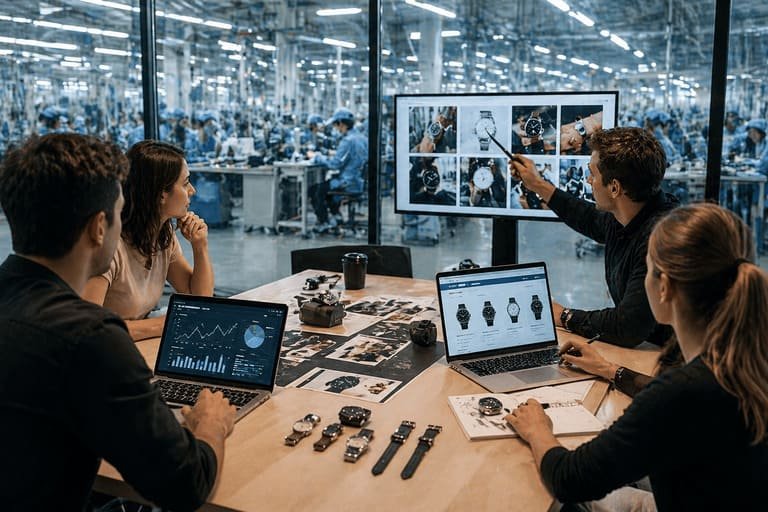
Ce modèle est axé sur la concentration et la gestion des risques. Construire et gérer une usine est une activité complètement différente de la création d'une marque.. Cela nécessite un investissement massif en capital, expertise en opérations, et gérer un effectif important. En externalisant, MVMT évite tout ça.
Avantage 1: Évolutivité à la demande
Une marque comme MVMT connaît d'énormes pics de ventes pendant des vacances comme le Black Friday. Avec un modèle OEM, ils peuvent simplement augmenter la taille de leurs commandes auprès de plusieurs usines pour répondre à la demande.
S'ils possédaient une seule usine, leur capacité de production serait fixe. Soit ils seraient incapables de répondre à la demande, soit ils auraient un vide, usine chère pour le reste de l'année.
Avantage 2: Flexibilité et innovation
Le monde horloger évolue rapidement. Nouveaux matériaux, nouvelles techniques de revêtement, et de nouveaux styles émergent tout le temps. En faisant appel à un réseau de fournisseurs, MVMT peut facilement exploiter ces innovations.
Si une usine de Dongguan devient la meilleure dans un nouveau type de revêtement noir mat, leur société commerciale peut commencer à y passer des commandes. S'ils possédaient leur propre usine, ils seraient enfermés dans leur technologie existante.
Avantage 3: Concentrez-vous sur les points forts
Le génie de MVMT réside dans son marketing et la création d'une communauté directe avec les consommateurs.2 Ce modèle de fabrication OEM libère tout leur capital et toute leur attention pour se concentrer sur ce qu'ils font de mieux.: créer une marque désirable et vendre des montres en ligne.
| Fonctionnalité | Modèles OEM (Externalisation) | Usine interne (Posséder) |
|---|---|---|
| Coût initial | Faible | Très élevé |
| Flexibilité | Haut (peut changer de fournisseur) | Faible (capacité fixe) |
| Risque | Faible (partagé avec le fournisseur) | Haut (tout sur la marque) |
| Se concentrer | Commercialisation & Marque | Fabrication & Opérations |
Conclusion
Le succès de MVMT n'est pas seulement marketing; c'est une stratégie de fabrication intelligente. Ils utilisent un réseau d'usines chinoises spécialisées, géré par des partenaires de Hong Kong, pour construire leur marque efficacement.
"MVMT Watches - Wikipedia", https://en.wikipedia.org/wiki/MVMT_Watches. La région du delta de la rivière des Perles, dont Shenzhen et Dongguan, est largement reconnu comme une plaque tournante de la fabrication d’appareils électroniques grand public et de montres en raison de son réseau dense de fournisseurs et d’usines spécialisés. Rôle de la preuve: support_général; type de source: institution. Prise en charge: Confirme les sites de fabrication et le modèle OEM utilisé par MVMT.. Note sur la portée: La source ne fait peut-être pas directement référence à MVMT, mais soutient les pratiques générales de l'industrie dans la région.. ↩
"How MVMT Cracked The Code On Direct-to-Consumer Growth | Yotpo", https://www.yotpo.com/blog/mvmt-cracked-code-direct-consumer-growth/. Les marques destinées directement aux consommateurs réussissent souvent grâce à des stratégies de marketing ciblées et à la promotion de communautés de consommateurs fortes., comme le montre l'approche de MVMT. Rôle de la preuve: expert_consensus; type de source: recherche. Prise en charge: Explique l'importance du marketing et du renforcement de la communauté pour les marques destinées directement aux consommateurs comme MVMT.. Note sur la portée: La source peut décrire des pratiques générales sans référence spécifique à MVMT. ↩