
Vous rêvez de votre propre marque de montre mais vous avez peur du coût potentiel? C'est une peur commune. Mais lancer votre marque est plus abordable que vous ne le pensez.
Vous pouvez créer une marque de montres pour aussi peu que $3,000 à $9,0001. Ce budget couvre votre premier petit lot de montres (100-300 pièces2) avec votre logo, plus un emballage de base. Cela permet aux nouveaux entrepreneurs d'entrer sur le marché sans un investissement énorme..
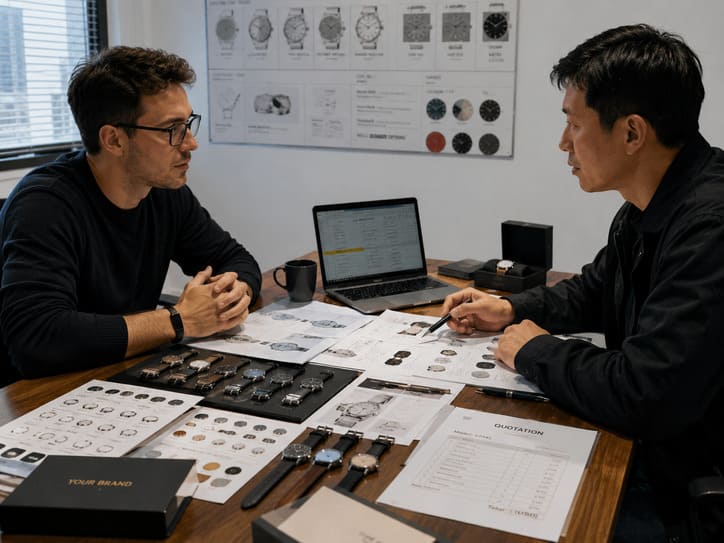
Créer une marque ressemble à une immense montagne à gravir, surtout quand on pense à l'argent. Je parle chaque jour à de nouveaux propriétaires de marques, et la première question concerne toujours le coût. Beaucoup pensent qu’ils ont besoin de dizaines de milliers de dollars juste pour commencer. La bonne nouvelle c'est que ce n'est pas vrai. Vous avez des options, et les comprendre est la première étape. Décomposons les chiffres réels afin que vous puissiez voir comment transformer votre idée en un véritable produit que vous pouvez vendre..
Quel est le budget minimum pour lancer une marque horlogère?
Se sentir coincé parce que tu penses avoir besoin $50,000 pour commencer? C'est un mythe courant qui retient les gens. La réalité est bien plus accessible.
Vous pouvez créer une marque de montres pour aussi peu que $3,000 pour un micro-lot ou environ $9,000 pour un premier run plus personnalisé. L'option la moins coûteuse utilise des conceptions existantes, tandis que le budget plus élevé permet une personnalisation plus unique sur une commande plus importante.
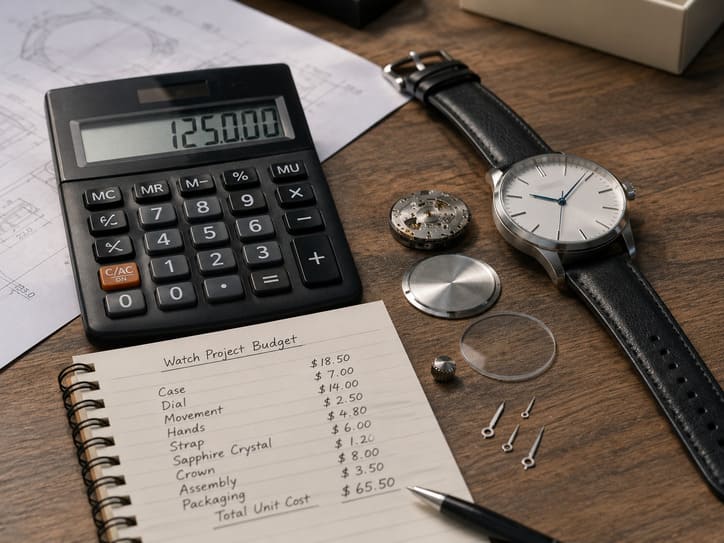
Le budget dépend vraiment de votre premier objectif. Vous souhaitez tester le marché rapidement, ou lancez-vous avec un design plus unique? Les deux sont d’excellentes stratégies, mais ils viennent avec des étiquettes de prix différentes. J'ai travaillé avec des fondateurs qui ont commencé avec les deux approches. La clé est d’adapter votre budget à votre plan d’affaires. Examinons les deux principales voies que vous pouvez emprunter pour votre premier cycle de production.
Le micro-lancement vs. Le lancement personnalisé
Votre investissement de départ est directement lié à votre Quantité minimum de commande (MOQ)3 et niveau de personnalisation4.
- Le micro-lancement (autour $3,000): C'est le point d'entrée idéal. Vous choisissez parmi l'un de nos, des modèles de boîtiers prêts à la production et nous ajoutons votre logo et votre cadran personnalisés. Parce que l'outillage est déjà réalisé, nous pouvons offrir un MOQ inférieur, souvent autour 100 pièces. C'est à faible risque et c'est le moyen le plus rapide de commercialiser votre produit..
- Le lancement personnalisé (autour $9,000): Si vous avez un design plus spécifique en tête, c'est ton chemin. Ce budget couvre généralement un MOQ de 300 pièces. Cela vous donne plus de liberté pour personnaliser le cadran, mains, fond du boîtier, et d'autres détails pour créer une montre qui vous ressemble vraiment.
Voici un tableau simple pour comparer les deux options:
| Fonctionnalité | Micro-lancement (100 pièces) | Lancement personnalisé (300 pièces) |
|---|---|---|
| Coût estimé | ~3 000$ | ~9 000 $ |
| Unicité de conception | Moyen (Cadran personnalisé) | Haut (Plus de pièces personnalisées) |
| Niveau de risque | Faible | Modéré |
| Délai de mise sur le marché | Plus rapide | Plus long |
Comment se répartissent les coûts unitaires des montres?
Vous ne savez pas ce que vous payez réellement pour une seule montre? Il est facile de se perdre dans les guillemets. Rendons les choses simples et claires.
Un typique Les montres personnalisées d'entrée de gamme coûtent environ $20-$25 par unité de l'usine5. Ce prix comprend la tête de montre (cas, mouvement, cadran, mains) et une sangle standard. Matériaux haut de gamme, comme un mouvement suisse ou une glace saphir, augmentera ce coût de base6.
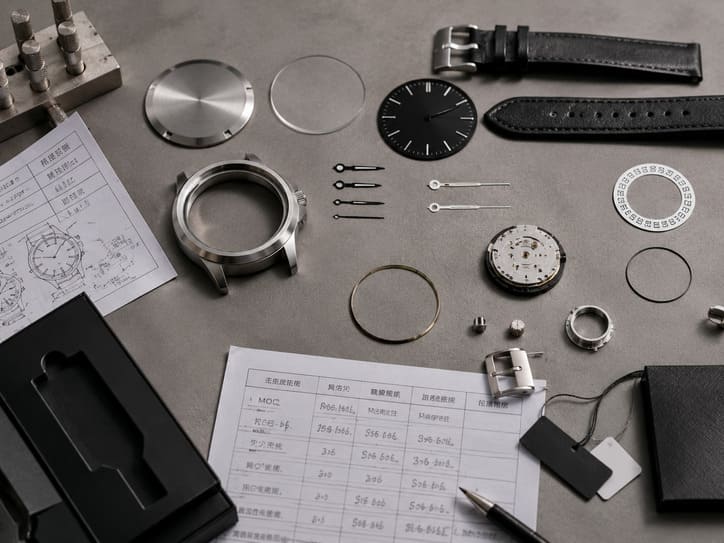
Lorsque vous recevez un devis d'un fabricant, tu regardes le "départ usine7" prix. C'est le coût de fabrication d'une montre complète. Mais qu'est-ce qui compose ce prix? Ce n'est pas qu'une chose; c'est une somme de toutes les petites pièces et du travail nécessaire pour les assembler. Comprendre ces composants vous aide à faire des choix de conception intelligents qui correspondent à votre budget. Par exemple, changer le mouvement est l’un des principaux facteurs pouvant affecter le prix. Passons à un exemple typique.
Anatomie d'un $22 Montre
Imaginons que vous souhaitiez créer une montre à quartz classique. Le coût unitaire peut être d'environ $22. Où va cet argent? Le coût est une combinaison de matériaux et d'assemblage. De meilleurs matériaux coûtent plus cher, mais ils créent également un meilleur produit pour vos clients.
Voici un exemple de répartition de la façon dont cela $22 pourrait être distribué:
| Composant | Exemple de matériau/type | Coût estimé |
|---|---|---|
| Mouvement | Quartz japonais Miyota8 | $5.00 |
| Cas | 316L Acier inoxydable9 | $8.00 |
| Cadran & Mains | Conception personnalisée, Laiton | $3.00 |
| Sangle | cuir véritable | $4.00 |
| Assemblée & QC | Travail et tests | $2.00 |
| Coût unitaire total | $22.00 |
En plus de ça, tu as un emballage. Un simple, la boîte de marque pourrait en ajouter une autre $2.00 par unité. Donc, le coût total de votre produit avant expédition et taxes est de $24.00. Si vous souhaitez mettre à niveau, vous pouvez passer à un mouvement suisse Ronda ou ajouter une glace saphir, mais chaque mise à niveau ajoutera quelques dollars au coût unitaire.
Votre devis d'usine semble superbe, mais est-ce le prix final? Des frais inattendus peuvent ruiner votre budget. Découvrons les coûts que vous avez peut-être manqués.
Oui, il y a des coûts au-delà de la fabrication. Vous devez prévoir un budget pour l'expédition, droits d'importation, et les impôts. L'expédition peut ajouter $2-$4 par montre, et les impôts peuvent être 20-25% ou plus de la valeur totale de votre commande10, selon les règles de votre pays.
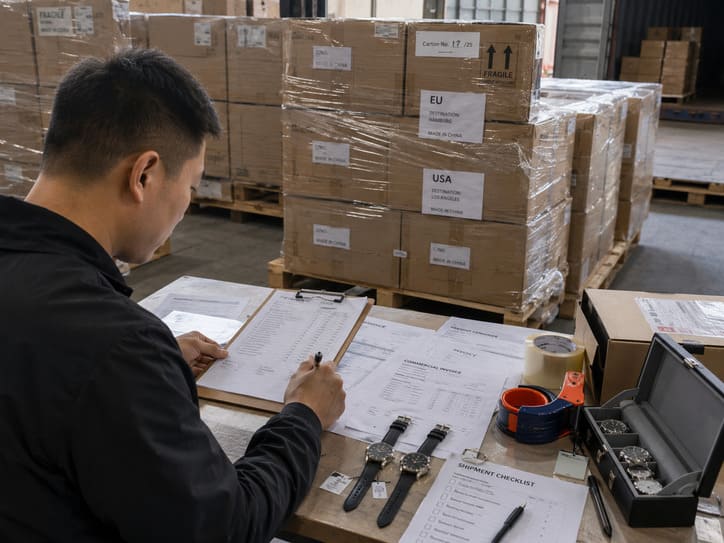
Je dis toujours à mes clients de réfléchir à "coût au débarquement11," pas seulement le prix d'usine. Le coût au débarquement est le prix final que vous payez pour mettre le produit entre vos mains., prêt à vendre. Oublier cela est une erreur courante pour les nouveaux propriétaires de marque. Cela peut transformer un plan rentable en perte. Ces coûts ne proviennent pas du fabricant; ils font partie du commerce international. Passons en revue les principaux pour que vous puissiez préparer un budget réaliste et éviter toute mauvaise surprise..
Budgétisation du coût au débarquement
Votre véritable coût par montre comprend trois éléments clés au-delà du prix d'usine.
-
Expédition: Pour les petits lots de 300-500 montres, le fret aérien est la méthode la plus courante. C'est plus rapide et plus sûr que le transport maritime. En règle générale, vous pouvez estimer les frais d'expédition entre $2 à $4 par montre lors d'une expédition de la Chine vers l'Europe ou les États-Unis. Donc pour une commande de 300 pièces, c'est un extra $600 à $1,200.
-
Droits d'importation & Impôts: C'est la plus grande variable et dépend entièrement de votre pays. Lorsque vous importez des marchandises, votre gouvernement vous facturera des droits et taxes (comme la TVA ou la TPS). Je conseille souvent aux clients de budgétiser autour 25% de la valeur totale de la facture commerciale (coût du produit + expédition) pour ça. Pour un $7,200 commande ($24/unité x 300), cela pourrait être un supplément $1,800. Vérifiez toujours les réglementations d'importation de votre gouvernement local pour connaître les tarifs exacts..
-
Échantillons: Avant de passer une commande groupée, tu as besoin d'échantillons. Les coûts des exemples sont distincts et peuvent varier de $100 à $800 sur moule existant, va de $500-$3000 en fonction de la complexité. Il s'agit d'un investissement nécessaire pour garantir que la qualité et le design correspondent exactement à ce que vous souhaitez..
Comment puis-je réduire mes coûts de démarrage?
Est-ce que le $9,000 le prix reste un peu élevé? N'abandonnez pas encore votre marque. Il existe des moyens intelligents de commencer petit et de grandir.
Le moyen le plus simple de réduire les coûts de démarrage est de réduire votre quantité minimale de commande. (MOQ). En choisissant le design de boîtier existant d'un fabricant et en ajoutant simplement votre logo et votre cadran personnalisé, vous pouvez souvent réduire le MOQ de 300 juste pour 100 pièces.
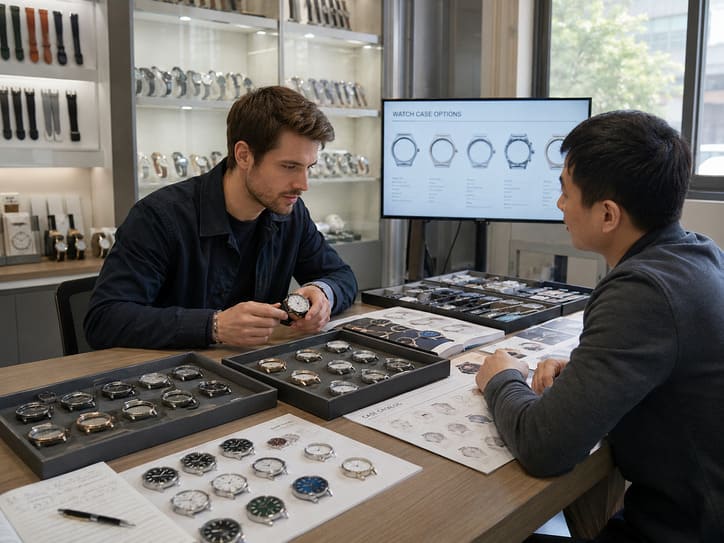
Le désir de créer quelque chose 100% unique dès le premier jour est fort. Je le vois chez presque tous les fondateurs passionnés que je rencontre. Mais un la conception entièrement personnalisée nécessite de nouveaux moules et outils12, c'est pourquoi les fabricants ont besoin d'un MOQ plus élevé pour couvrir ces coûts. Cependant, a smarter way to start is by using what we call "open mold" or "factory stock" cas. Ce sont de haute qualité, des conceptions éprouvées pour lesquelles nous disposons déjà des outils. Cela nous permet de produire un lot beaucoup plus petit pour vous, ce qui est parfait pour tester votre marque.
Le pouvoir de partir d’une conception existante
Choisir un modèle de boîtier existant est la stratégie la plus efficace pour se lancer avec un budget serré. Cela ne veut pas dire que votre montre aura l'air générique. Vous avez toujours un contrôle total sur les éléments visuels les plus importants qui définissent votre marque.
Voici comment cette approche vous fait gagner du temps et de l'argent:
- MOQ inférieur (100 pièces): C'est le plus gros avantage. Une commande de 100 unités au lieu de 300 peut ramener votre investissement initial à cela $3,000 gamme.
- Aucun frais d'outillage: Créer de nouveaux moules pour une coque personnalisée peut coûter des milliers de dollars. L'utilisation d'une conception existante élimine complètement cette dépense.
- Production plus rapide: Puisque les dessins techniques et les outils sont prêts, nous pouvons passer à l'échantillonnage et à la production beaucoup plus rapidement. Vous pouvez avoir vos montres en main des semaines plus tôt qu'avec un projet entièrement personnalisé.
- Personnalisation complète du cadran: Le cadran est le cadran de votre montre. Vous pouvez toujours le concevoir à partir de zéro : la couleur, les marqueurs, les mains, et votre logo. C'est là que l'identité de votre marque brille vraiment.
J'ai vu de nombreuses marques à succès commencer de cette façon. Ils se lancent avec une collection de 100 pièces, prouver leur concept, et réinvestir leurs bénéfices dans un design entièrement personnalisé pour leur deuxième collection.
Conclusion
Créer une marque horlogère est à portée de main, avec un budget réaliste de $3,000 à $9,000 pour votre premier inventaire. La clé est de commencer intelligemment en choisissant la bonne stratégie de fabrication.
"Small Batch Manufacturing Startup Costs: $465K CAPEX", https://Financialmodelslab.com/blogs/startup-costs/small-batch-production?srsltid=AfmBOooyxTPLdHqkol12MxxaIj53rx4bSfUWICCYhxUPNWCbe4WDIXKA. Une petite entreprise neutre ou une source de coûts de fabrication devrait permettre de lancer des produits de consommation de marque privée avec des budgets d'inventaire initiaux relativement faibles en utilisant des conceptions existantes et une personnalisation limitée.; cela contextualiserait, mais pas de vérification indépendante, l'estimation spécifique de l'article de 3 000 $ à 9 000 $. Rôle de la preuve: support_général; type de source: institution. Prise en charge: Une marque horlogère peut être lancée avec un budget initial d'environ $3,000 à $9,000.. Note sur la portée: La source citée peut généralement soutenir le modèle de marque privée à petit budget plutôt que la fourchette de prix exacte de la marque horlogère.. ↩
"A 2026 Guide de la quantité minimale de commande (MOQ) - Impact Analytics", https://www.impactanalytics.ai/blog/moq. Une source de fabrication ou de chaîne d'approvisionnement doit documenter que des quantités minimales de commande sont couramment utilisées dans la fabrication sous contrat et que la production en petits lots peut impliquer des commandes de l'ordre de quelques centaines.; cela confirme la plausibilité de la taille de lot indiquée mais peut ne pas établir de normes spécifiques à la montre. Rôle de la preuve: support_général; type de source: éducation. Prise en charge: Un premier petit lot pour une nouvelle marque horlogère peut vraisemblablement comprendre 100 à 300 pièces.. Note sur la portée: La prise en charge peut concerner généralement les MOQ de fabrication sous contrat, pas spécifiquement pour les montres. ↩
"[PDF] Optimisation de la quantité minimale de commande de matières premières - DSpace@MIT", https://dspace.mit.edu/bitstream/handle/1721.1/121302/1240293813-MIT.pdf?séquence=1. Une référence de chaîne d'approvisionnement ou de fabrication doit définir la quantité minimale de commande comme la plus petite quantité qu'un fournisseur est prêt à produire ou à vendre en une seule commande., soutenant l'utilisation dans l'article du MOQ comme contrainte clé de coût de production. Rôle de la preuve: définition; type de source: éducation. Prise en charge: La quantité minimale de commande est le volume minimum de production ou d’achat requis par un fournisseur.. ↩
"[PDF] Analyzing Product Lifecycle Costs for a Better Understanding of Cost ...", http://utw10945.utweb.utexas.edu/Manuscripts/2012/2012-12-Lindemann.pdf. Une source en économie manufacturière devrait expliquer que la personnalisation augmente la configuration fixe, ingénierie, outillage, ou frais de changement, qui sont répartis sur la quantité commandée; cela soutient le mécanisme liant la personnalisation à un investissement requis plus élevé. Rôle de la preuve: mécanisme; type de source: éducation. Prise en charge: Une plus grande personnalisation peut augmenter les coûts d’installation de fabrication ou d’outillage et donc augmenter l’investissement de départ.. Note sur la portée: Le principe est général à la fabrication et peut ne pas quantifier spécifiquement les coûts de production horlogère.. ↩
"[PDF] CHAPITRE HTS 91 CLOCKS AND WATCHES AND PARTS THEREOF", https://www.usitc.gov/publications/docs/tata/hts/bychapter/1000c91.pdf. Un coût pour l'industrie, données d'importation, ou une source de référence en matière de fabrication doit prouver que les montres à quartz à faible coût peuvent avoir des valeurs unitaires déclarées en usine ou en douane en dizaines de dollars.; cela confirmerait la plausibilité de l'estimation de 20 $ à 25 $, mais pourrait ne pas prouver le devis exact du fournisseur.. Rôle de la preuve: statistique; type de source: institution. Prise en charge: Une montre personnalisée d'entrée de gamme peut coûter environ 20 à 25 dollars par unité au niveau de l'usine.. Note sur la portée: Les prix d'usine varient considérablement selon le fournisseur, matériels, taille de la commande, et pays de fabrication. ↩
"Sapphire crystal [Regarder Wiki]", https://www.watch-wiki.net/doku.php?identifiant = saphir_cristal. Une référence en matière d'horlogerie ou de matériaux doit confirmer que le verre saphir et les mouvements de montre de qualité supérieure sont des composants de qualité supérieure par rapport au verre minéral et aux mouvements à quartz de base.; cela conforte la direction de l'augmentation des coûts sans quantifier le montant ajouté. Rôle de la preuve: support_général; type de source: encyclopédie. Prise en charge: L’utilisation de composants haut de gamme tels que le verre saphir ou les mouvements suisses augmente le coût de base d’une montre.. Note sur la portée: La source peut établir des différences de qualité des composants plutôt que de fournir des majorations de prix exactes.. ↩
"Export Import | Qu'est-ce que le départ usine? - Digital Exim", https://digitalexim.com/export-import-what-is-ex-factory/. Une référence commerciale internationale doit définir le prix départ usine ou départ usine comme le prix des marchandises dans les locaux du vendeur avant transport., assurance, devoirs, et autres coûts en aval; cela conforte la distinction entre le prix d'usine et le coût au débarquement. Rôle de la preuve: définition; type de source: institution. Prise en charge: Un prix départ usine exclut une expédition ultérieure, importer, impôt, et les frais associés.. ↩
"Miyota (fabricant de mouvements de montre) - Wikipedia", https://en.wikipedia.org/wiki/Miyota_(watch_movement_manufacturer). Une référence horlogère ou une spécification du fabricant doit identifier Miyota en tant que fabricant japonais de mouvements horlogers et documenter que les mouvements à quartz sont largement utilisés dans les montres alimentées par batterie.; cela prend en charge l'exemple de composant plutôt que la répartition exacte des coûts de l'article. Rôle de la preuve: référence_cas; type de source: autre. Prise en charge: Les mouvements à quartz japonais Miyota constituent un choix de composant plausible pour une montre à quartz d'entrée de gamme.. Note sur la portée: La source vérifierait le type et l'origine du composant, pas ce qui est indiqué $5.00 coût. ↩
"Improving Corrosion and Wear Resistance of 316L Stainless Steel ...", https://pmc.ncbi.nlm.nih.gov/articles/PMC11818221/. Une source de matériaux ou d'ingénierie doit décrire l'acier inoxydable 316L comme un acier inoxydable austénitique résistant à la corrosion et couramment utilisé dans les applications grand public ou médicales.; cela explique pourquoi il s'agit d'un matériau plausible pour le boîtier de montre, sans valider le prix indiqué. Rôle de la preuve: définition; type de source: éducation. Prise en charge: 316L'acier inoxydable est un matériau reconnu résistant à la corrosion et adapté aux boîtiers de montres.. Note sur la portée: La source prend en charge les propriétés matérielles et le contexte d'utilisation, pas l'estimation de l'article $8.00 coût du cas. ↩
"Customs Duty Information - NOUS. Customs and Border Protection", https://www.cbp.gov/travel/international-visitors/know-before-you-visit/customs-duty-information. Les sources douanières et fiscales gouvernementales doivent montrer que les taux de TVA ou de TPS à l'importation dans de nombreuses juridictions sont proches 20% ou supérieur et peut être appliqué à la valeur en douane plus les frais d'expédition et les droits de douane; cela conforte la plausibilité de la fourchette budgétaire, bien que les taux réels dépendent du pays et de la classification du produit. Rôle de la preuve: statistique; type de source: gouvernement. Prise en charge: Les taxes à l’importation peuvent atteindre environ 20 à 25 % ou plus de la valeur d’une commande selon le pays de destination.. Note sur la portée: Les tarifs varient selon la juridiction, Code HS, méthode d'évaluation, exemptions, et accords commerciaux. ↩
"Duty - Coût d'assurance et de fret (CIF) - help.CBP.gov", https://www.help.cbp.gov/s/article/Article1126. Une source commerciale ou douanière doit définir le coût au débarquement comme le coût total des marchandises importées après avoir ajouté le fret., assurance, devoirs, impôts, et frais associés; cela conforte l'avertissement de l'article selon lequel le prix d'usine n'est pas le coût final. Rôle de la preuve: définition; type de source: gouvernement. Prise en charge: Le coût au débarquement comprend le prix d'usine plus les frais d'expédition, devoirs, impôts, et autres dépenses liées à l'importation.. ↩
"How to Estimate Injection Molding Cost?", https://formlabs.com/blog/injection-molding-cost/. Une source de processus de fabrication doit expliquer que les pièces conçues sur mesure nécessitent souvent un outillage, moules, meurt, ou montages avant production, soutenant l'affirmation de l'article selon laquelle les conceptions de montres entièrement personnalisées créent des coûts initiaux supplémentaires. Rôle de la preuve: mécanisme; type de source: éducation. Prise en charge: Les conceptions de produits entièrement personnalisés nécessitent généralement de nouveaux moules ou outils, en ajoutant les coûts de fabrication initiaux.. Note sur la portée: La source peut décrire l'outillage de fabrication en général plutôt que les boîtiers de montres en particulier.. ↩